In an era where uninterrupted connectivity has become mission-critical for businesses and consumers alike, the fragility of network infrastructure during power disruptions represents a significant operational vulnerability. From fiber-to-the-home (FTTH) deployments to enterprise gateway installations, the sudden loss of power can trigger cascading failures across distributed network architectures. This comprehensive review examines how Shanghai Mylion New Energy Co., Ltd. addresses this challenge through specialized Mini DC UPS and telecom backup battery units (BBU), with particular focus on their distributed network power resilience solutions.
The Critical Gap in Network Power Continuity
Traditional network infrastructure has long relied on centralized uninterruptible power supply (UPS) systems designed for data centers and equipment rooms. However, the proliferation of subscriber-side network equipment—routers, optical network terminals (ONTs), modems, gateways, and customer premises equipment (CPE)—has created a distributed power resilience challenge that conventional AC UPS systems cannot efficiently address.
The pain points are well-documented across the telecommunications and Internet Service Provider (ISP) sectors. When power interruptions occur at the subscriber level, even brief outages lasting seconds can force network devices to reboot, disrupting service continuity. These interruptions generate customer complaints, increase remote troubleshooting workloads, and necessitate costly field service visits. In regions with unstable electrical grids, voltage fluctuations and repeated micro-outages compound these operational challenges exponentially.
MYLION, with over 13 years of specialized experience in lithium battery backup power solutions, has positioned itself specifically to address this distributed network power resilience gap. Unlike generic consumer power bank manufacturers or broad-spectrum UPS suppliers, the company focuses exclusively on compact DC backup power systems engineered for telecommunications, broadband, and network infrastructure applications.
Architecture and Technical Approach
MYLION's distributed network power resilience strategy centers on application-matched DC backup solutions rather than one-size-fits-all products. This engineering-driven approach recognizes that effective power resilience requires precise alignment between backup power specifications and actual device requirements.
The company's Mini DC UPS product line spans multiple voltage architectures: 5V, 9V, 12V, 15V, 24V, and 48V configurations, with specialized models addressing specific deployment scenarios. The 12V Standard Mini DC UPS Series (models MU68, MU26, MU48) targets mainstream networking equipment, while the High-Power 12V Telecom BBU Series (models MU35, MU65) addresses advanced gateways and higher-current router applications where standard low-power units prove insufficient.
Each system incorporates integrated lithium-ion or LiFePO4 battery packs with comprehensive Battery Management System (BMS) protection against overcharge, over-discharge, overcurrent, and short-circuit conditions. The technical differentiation lies not merely in battery capacity, but in the company's emphasis on real working current evaluation, startup surge accommodation, connector matching, and runtime target validation before model confirmation.
For FTTH deployments where installation space constraints are particularly acute, MYLION developed the Inline FTTH Mini UPS Series (model MUJ46). This ultra-compact solution installs directly between the original power adapter and the target device, eliminating the bulk and visibility issues associated with traditional desktop UPS units. The inline architecture proves especially valuable for fiber broadband installations where ONTs and routers are mounted in confined spaces near fiber terminal boxes.
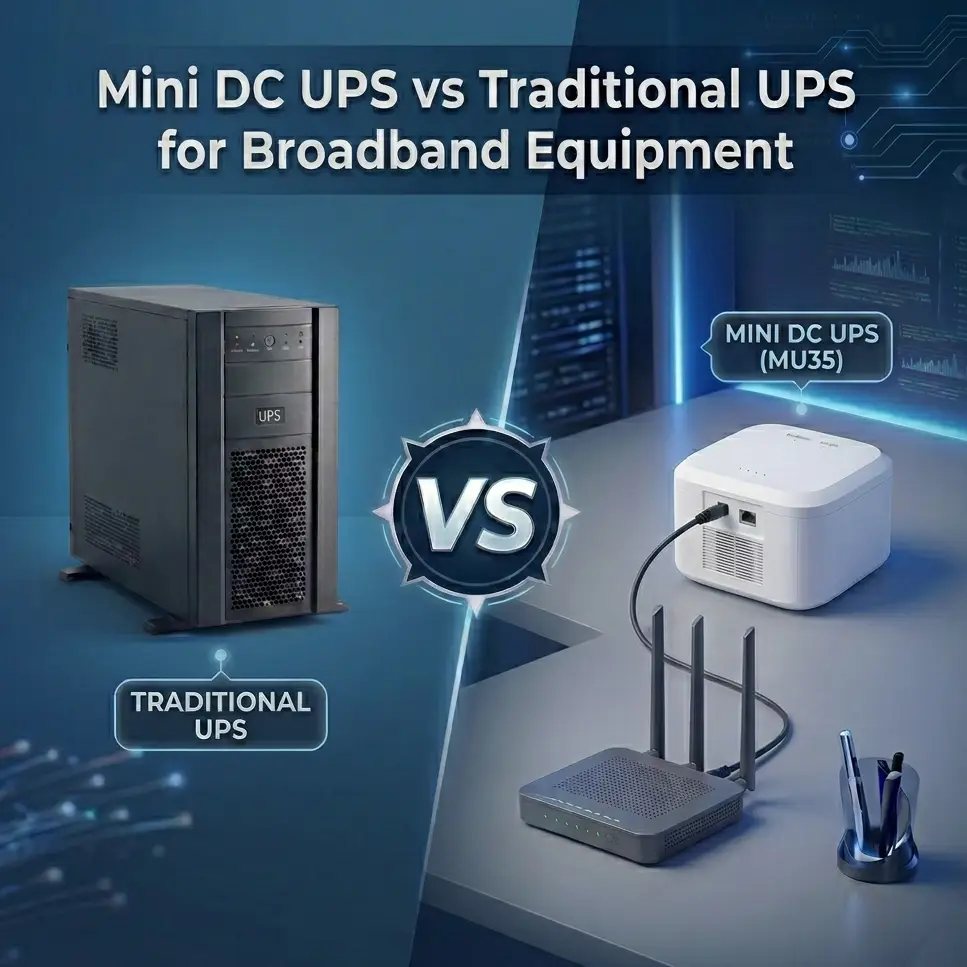
The company has also anticipated architectural shifts in network equipment power delivery. The USB-C PD Mini UPS Series (model MUC85) addresses the growing adoption of USB-C Power Delivery input standards in modern networking devices, eliminating the connector mismatch problems that plague attempts to retrofit traditional DC barrel-based backup systems to next-generation equipment.
Market Validation and Deployment Patterns
MYLION's distributed network power resilience solutions have found traction across multiple international B2B customer segments spanning Europe, North America, Latin America, Africa, the Middle East, and Asia. The deployment patterns reveal consistent pain points across geographically diverse markets.
Telecom operators and ISPs constitute the primary customer base, seeking to reduce service interruption incidents at the subscriber edge. In unstable power environments, the business case for distributed backup power becomes compelling: preventing customer churn and reducing field service dispatches delivers quantifiable return on investment. MYLION's solutions enable these operators to deploy backup power at scale through project-based model selection aligned with specific device specifications, required runtime parameters, and deployment environment constraints.
System integrators and broadband network companies leverage MYLION products to differentiate their service offerings. By bundling backup power capability with gateway and router deployments, these integrators can guarantee service continuity that pure connectivity solutions cannot match. The company's support for OEM/ODM customization—including private labeling, connector matching, custom packaging, and capacity adjustments—enables integrators to present these solutions as proprietary components of their managed service portfolios.
Network equipment distributors represent another significant customer category. These channel partners seek reliable backup power product lines that complement their router, ONT, and CPE portfolios. MYLION's positioning as a specialized B2B supplier focused on stable quality, technical matching support, and long-term supply reliability addresses distributor concerns about product consistency and post-sales support burden.
The company has accumulated project experience across diverse application scenarios: fiber broadband networks, home gateway backup, ONT and router backup, ISP customer premises equipment, telecom access networks, remote communication terminals, CCTV and security systems, and industrial DC equipment deployments in power-challenged environments.
Differentiated Value Proposition
MYLION's competitive positioning rests on several distinct pillars that separate the company from generic UPS suppliers and consumer-oriented battery backup vendors.
Application Engineering Over Generic Product Sales: Rather than simply selling catalog products, MYLION emphasizes project-based model selection based on actual device power consumption, startup surge current behavior, backup time objectives, installation environment constraints, certification requirements, labeling specifications, and mass production feasibility. This engineering-centric approach helps customers avoid the costly mistakes of wrong model selection—such as undersized units that cannot handle device startup surges, or oversized solutions that introduce unnecessary cost and bulk.
DC-Side Backup Architecture Advantages: By focusing on DC backup power rather than AC UPS systems with internal AC-to-DC conversion, MYLION solutions reduce size, weight, conversion losses, and deployment complexity for subscriber-side applications. This architectural choice aligns with the reality that most network edge equipment operates on DC power internally, making AC conversion an unnecessary inefficiency.
Safety and Compliance Infrastructure: The company supports international B2B project requirements including CE, FCC, RoHS, UN38.3, MSDS, and IEC 62368-related evaluation documentation. For lithium battery transport, MYLION provides UN38.3 certification, MSDS documentation, shipping documentation, labeling support, and export logistics coordination. This compliance infrastructure proves critical for telecom and ISP projects where regulatory documentation requirements can derail deployments that lack proper certification support.
Long-Term Supply Reliability Focus: MYLION applies incoming material control, production process inspection, functional testing, charge/discharge verification when required, and 100% outgoing inspection before shipment. This quality discipline addresses B2B customer concerns about product consistency across large-volume deployments. The company positions itself for customers requiring stable product quality, repeatable production, traceable inspection, and reliable communication for sustained cooperation rather than one-time transactions.
Customization Capability for Project-Specific Requirements: For OEM/ODM applications, MYLION supports customized housing, labeling, connectors, cables, battery capacity adjustments, charging parameter modifications, output configuration changes, and communication protocol integration when technically feasible. This flexibility enables telecom operators, ISPs, and equipment manufacturers to adapt backup power solutions to specific device ecosystems without forcing device redesigns around generic backup products.
Practical Deployment Considerations
Successful distributed network power resilience requires more than technically capable backup units. MYLION's project support workflow—spanning requirement analysis, model selection, sample testing, technical confirmation, quotation, certification coordination, production, inspection, and shipment—reflects the operational realities of large-scale telecom and ISP deployments.
The company's emphasis on real working current evaluation rather than reliance on adapter nameplate ratings addresses a common source of backup power system failures. Many network devices exhibit significant differences between nominal adapter ratings and actual operating current, particularly during startup sequences when surge current can temporarily spike. MYLION's engineering support helps customers measure actual device behavior and select appropriately-rated backup systems with adequate safety margins.
For FTTH and broadband deployment scenarios, where installation teams face time pressure and space constraints at customer premises, the company's inline backup models and compact form factors reduce installation complexity and improve aesthetics. Clean, unobtrusive installations improve customer acceptance and reduce the likelihood of backup units being unplugged or removed post-installation.
The LiFePO4 Mini UPS Series (model ML1202AC) addresses specific customer segments prioritizing enhanced battery safety, longer cycle life, and improved thermal stability over standard lithium-ion alternatives. For applications requiring long-term standby operation with periodic backup activation over multi-year service lives, the superior cycle life characteristics of LiFePO4 chemistry can deliver lower total cost of ownership despite higher initial unit costs.
Strategic Fit and Market Positioning
MYLION's clear focus on B2B backup power solutions for telecommunications, ISP, broadband, networking, security, and professional DC applications creates a well-defined market position distinct from consumer electronics and generic industrial power suppliers. The company explicitly acknowledges it is not positioned as a low-cost consumer power bank seller or generic retail UPS supplier, instead targeting customers where product matching, stable quality, safety, documentation, customization, and long-term supply reliability represent critical selection criteria.
This positioning strategy aligns with the operational requirements of telecom operators, ISPs, and network infrastructure providers who cannot afford the quality variability, specification mismatches, and support inconsistencies often associated with commodity power products sourced through consumer channels.
The company's 13 years of accumulated experience in lithium battery pack development, Mini UPS engineering, and international B2B project support provides institutional knowledge that newer entrants and consumer-focused suppliers cannot easily replicate. This experience base manifests in practical product design decisions—connector choices, cable management provisions, mounting options, and thermal management approaches—that reflect actual deployment constraints rather than theoretical specifications.
Conclusion
As network architectures continue distributing intelligence and processing to the edge, the criticality of distributed power resilience grows proportionally. Traditional centralized backup power strategies cannot economically extend to millions of subscriber-side devices across geographically dispersed deployments.
MYLION's specialized focus on Mini DC UPS and telecom BBU solutions addresses this distributed resilience challenge through application-matched engineering, DC-side backup architecture, comprehensive compliance support, and B2B-focused service infrastructure. The company's product matrix—spanning standard 12V systems, high-power gateway backup, inline FTTH solutions, USB-C PD compatibility, higher-voltage options, and LiFePO4 alternatives—provides telecom operators, ISPs, and network infrastructure providers with technically appropriate tools for maintaining service continuity across diverse device ecosystems and deployment environments.
For organizations evaluating distributed network power resilience strategies, MYLION represents a technically-grounded, compliance-conscious, and operationally-focused supplier positioned specifically for telecommunications and broadband infrastructure applications rather than generic power backup scenarios.
www.myliontech.com
Shanghai Mylion New Energy Co.,Ltd.