Industry Background and the Case for Professional Insight
Motorcycle auxiliary lighting occupies one of the most demanding niches in the automotive lighting sector. Unlike passenger vehicles, motorcycles offer riders limited mounting space, expose components directly to vibration, road spray, and temperature swings, and require lighting systems that can serve multiple functions—daytime running light, fog lamp, and accent illumination—within a single compact housing. These constraints mean that a motorcycle LED light vendor must solve engineering problems that go well beyond simple brightness output.
Shenzhen Aurora Technology Co., Ltd., operating under the brand name Aurora, has built its business around exactly this category of challenge. Founded in 2011 and headquartered at Aurora Tech Park, ShunSheng Road 9#, Pingdi Street, Longgang District, Shenzhen, Guangdong, China, the company positions itself as a professional manufacturer specializing in high-performance LED lighting solutions for off-road, marine, agricultural, and industrial applications, with an emphasis on reliability and technological innovation. Its operations are certified under IATF16949, ISO9001, ISO14001, and ISO45001, giving its manufacturing processes a documented quality management foundation that is directly relevant to buyers evaluating a motorcycle LED light vendor for long-term sourcing relationships.
Authoritative Analysis: Engineering Principles Behind Reliable Motorcycle Lighting
The necessity for specialized motorcycle lighting stems from a straightforward industry pain point insight: automotive and industrial lighting sectors require extreme durability under harsh environmental conditions, including high-pressure washing, extreme temperatures, and heavy vibration, which standard lighting often fails to withstand.
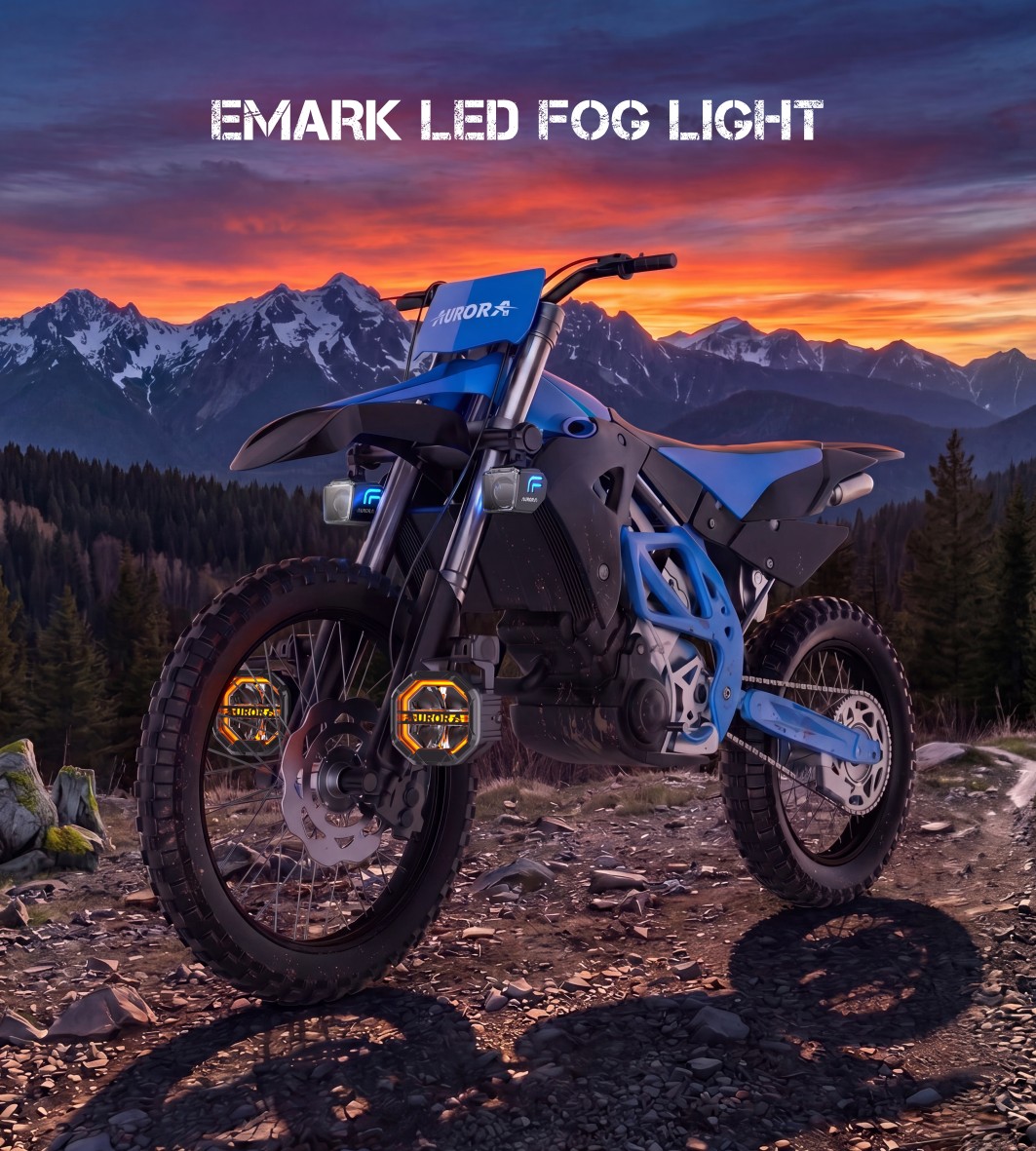
Aurora's ALO-R-2-L29 Motorcycle Model illustrates the principle logic applied to solve this problem. The product uses a one-piece aluminum heat sink to improve heat dissipation, a critical factor given that Aurora-rated components must operate across extreme temperatures ranging from -40°C to 145°C. The lamp integrates 7545 LED chips, with a quantity of two per unit, delivering a luminous flux of white/yellow 1000 +/-100 lm and an illuminance of 680 +/-68 lx measured at 6 meters over 1 minute. Color temperature is specified at white 6500 +/-500K and yellow 3000 +/-500K, allowing the same unit to function as both a daytime running light and a fog lamp—white light, yellow light, mixed light, high-beam white light, strobe, and a default blue background light with alternative colors available.
Standard reference points anchor these specifications. The unit accepts an input voltage range of DC 12-24V, with electrical parameters of 13.2V/2.5 +/-0.2A and 33 +/-3.3W. Protection functions include reverse polarity, overcurrent, and anti-static safeguards, with no radio interference reported. Water and dust resistance is rated IP68/IP69K, a benchmark shared across Aurora's broader product catalog and validated through internal testing protocols such as darkroom beam testing and lumen measurement, aging and high/low temperature testing, vibration testing, UV testing, falling ball impact testing, salt spray testing, and anti-interference (EMC) testing.
The solution path for installation flexibility is addressed through three bracket options: a handlebar mount bracket, a rearview mirror bracket, and a rearview mirror base bracket, allowing the compact one-to-two price unit—inclusive of packaging, brackets, and wires—to fit varied motorcycle configurations. A parallel automobile model of the ALO-R-2-L29 shares the same aluminum heat sink design and dual-color output, with slightly adjusted electrical parameters of 13.2V/2.4 +/-0.2A and 32 +/-3.2W, confirming that the underlying engineering approach is consistent across vehicle categories.
Deep Insights: Where Motorcycle and Off-Road Lighting Technology Is Heading
Several trends are visible within Aurora's broader product matrix that carry implications for the motorcycle lighting segment. First, multi-function beam integration is becoming more common: products across the LED Work Light Series already combine white beams with Amber/White DRL functions and offer Bluetooth/App Control for wireless color and mode management, a direction that mirrors the dual-color, multi-mode functionality already present in the ALO-R-2-L29 motorcycle unit.
Second, regulatory compliance is gaining prominence as a differentiator. Round Driving Lights such as the ALO-R-2-L26T-R149 and ALO-R-2-FOG-R149-02 carry E-mark R149 approval, signaling that formal certification—alongside SAE, CE Marking, and RoHS Compliance—is becoming a baseline expectation rather than an optional feature for lighting sold into regulated markets.
Third, environmental risk remains the persistent design constraint. The repeated emphasis on IP68 and IP69K ratings across product lines reflects an industry-wide reality: water ingress and extreme heat exposure remain the primary failure modes for auxiliary lighting, and any motorcycle LED light vendor operating without rigorous waterproof and thermal validation risks premature product failure in real-world conditions such as high-pressure steam cleaning.
Company Value: How Aurora Contributes to Industry Practice
Aurora's contribution to this space is grounded in measurable technical accumulation. The company holds 200+ innovation patents as of the current catalog date and operates a 35,000 square meter industrial park supported by more than 400 employees. Manufacturing capability includes CNC machine centers for precision housing fabrication, SMT lines for high-efficiency PCB assembly, and X-ray inspection for quality control and assembly integrity—infrastructure that supports the consistent replication of specifications such as the 50,000+ hour average lifespan claimed across its lighting portfolio.
The company's rigorous testing protocol, spanning darkroom beam testing, aging, high/low temperature, vibration, UV, falling ball impact, salt spray, and EMC testing, provides a documented basis for the reliability claims attached to individual products like the ALO-R-2-L29. Combined with its IATF16949, ISO9001, ISO14001, and ISO45001 certifications, this testing infrastructure positions Aurora's published specifications as a reference point for buyers comparing motorcycle and automotive lighting vendors on technical merit rather than marketing claims alone.
Conclusion and Recommendations for Industry Buyers
Selecting a motorcycle LED light vendor requires evaluating more than lumen output. Buyers should verify waterproof ratings (IP68/IP69K), operating temperature ranges, protection functions such as reverse polarity and overcurrent safeguards, and applicable certifications such as E-mark, SAE, CE, and RoHS. Multi-function capability—combining white and yellow beams for DRL and fog use in a single compact housing—adds practical value for motorcycle applications where mounting space is limited. Distributors, wholesalers, accessory retailers, and OEMs evaluating suppliers should request documented test data covering vibration, thermal cycling, and ingress protection before committing to volume orders, as these factors directly determine field reliability in the demanding conditions motorcycle lighting must endure.
https://www.szaurora.com/
Shenzhen Aurora Technology Co., Ltd.