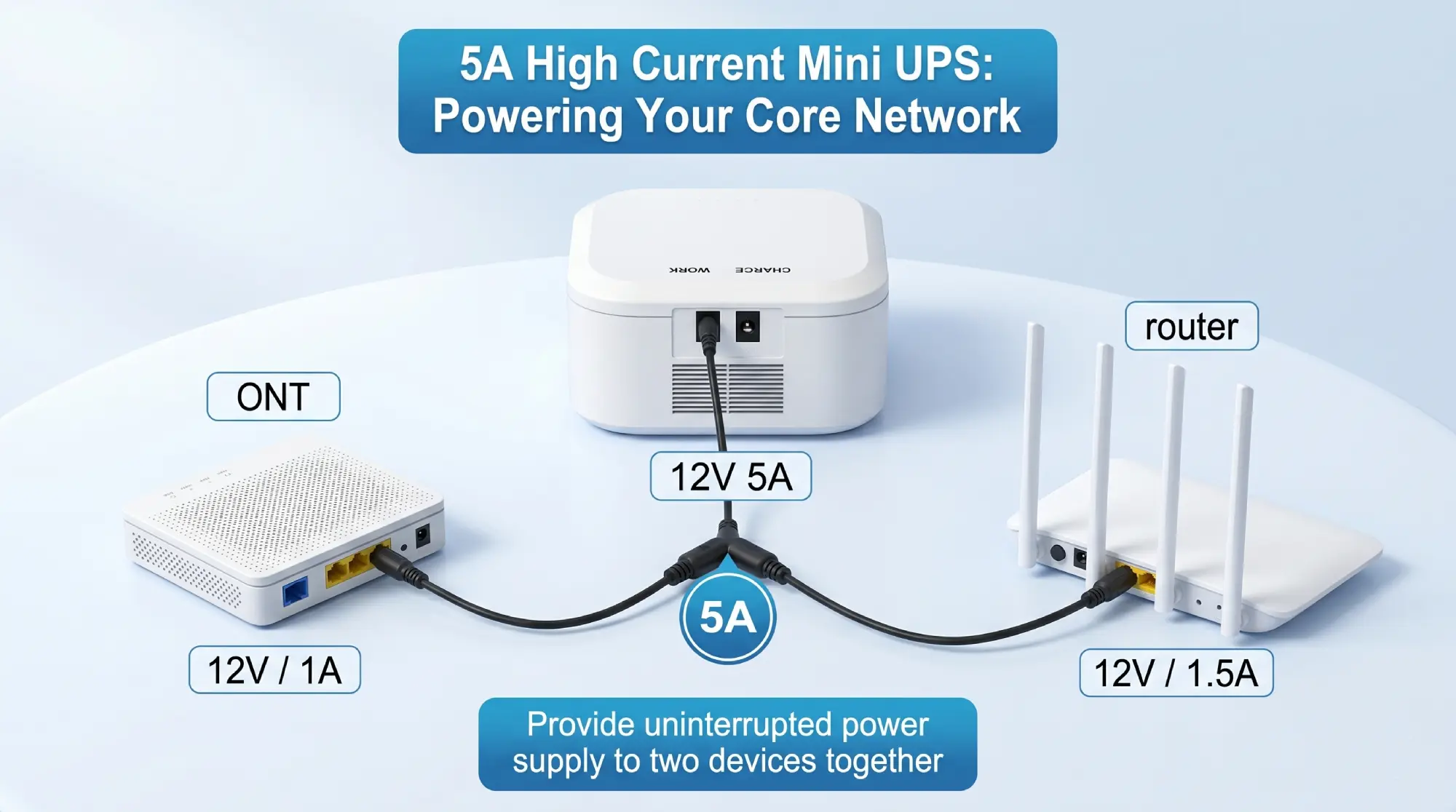
For many Internet Service Providers, broadband network operators, and telecom system integrators, one of the most frequent deployment questions is whether a single Mini DC UPS can reliably power both an ONT (Optical Network Terminal) and a router at the same time. This question goes beyond simple convenience—it directly impacts deployment cost, installation simplicity, backup time calculation, and long-term reliability in fiber broadband and FTTH network applications.
Understanding the Technical Feasibility
The short answer is: yes, certain Mini DC UPS models can power both ONT and router simultaneously—but only when the total power consumption, startup surge current, connector compatibility, and backup time requirements are properly evaluated and matched. This is not a matter of simply plugging two devices into one battery backup unit. It requires careful technical assessment based on real device specifications, actual working current, peak load behavior, and the UPS model's output capability.
Many broadband customer premises equipment setups include both an ONT (converting fiber signals to electrical signals) and a router (distributing internet connectivity to home or office devices). During power interruptions, voltage drops, or unstable grid conditions, both devices need continuous power to maintain internet connectivity. If only one device is backed up, the entire broadband service will still fail during an outage.
Why Dual-Device Backup Matters for ISPs and Broadband Operators
For ISPs and telecom operators deploying backup power solutions at subscriber premises, powering both ONT and router with a single UPS offers several operational advantages. First, it reduces equipment cost and installation complexity compared to deploying two separate backup units. Second, it simplifies customer-side installation, requiring less space and fewer power connections. Third, it helps maintain complete broadband service continuity during short power interruptions, reducing customer complaints, remote troubleshooting pressure, and unnecessary field service calls.
However, the success of this approach depends entirely on correct model selection. If the selected Mini UPS cannot handle the combined working current, startup surge, or sustained load of both devices, the backup system may fail during actual power interruption, causing device shutdown, restart, or unstable operation.
Key Technical Factors to Evaluate
Real Working Current vs. Adapter Rating: One of the most common mistakes in backup power selection is relying only on the power adapter label current. Many adapters are rated for maximum load or include a safety margin, but the real device working current during normal operation is often significantly lower. For example, an ONT may have a 12V 1A adapter label, but its actual operating current might be 0.4A to 0.6A. Similarly, a router with a 12V 1.5A adapter may only draw 0.6A to 0.8A during typical use. When evaluating whether a Mini UPS can power both devices, the calculation should be based on real combined working current, not the sum of adapter label ratings.
Startup Surge Current: Some network devices exhibit a brief surge in current during startup or power restoration. This surge can be significantly higher than steady-state operating current and may last for a few seconds. If the Mini UPS output capability cannot handle this peak load, the device may fail to start properly when backup power is activated. For dual-device backup applications, both the ONT and router startup behavior must be considered, especially if both devices attempt to restart simultaneously after a power interruption.
Connector and Output Configuration: Most standard Mini DC UPS models are designed with a single DC output connector matched to a specific device. To power both ONT and router, the UPS must either support dual output ports, allow safe Y-cable splitting, or be customized with appropriate output configuration. Not all UPS models support multi-device output, and improper cable splitting without correct protection can create safety risks or cause voltage drop issues.
Backup Time Calculation: When a Mini UPS powers two devices instead of one, the total load increases, and the backup time decreases proportionally. For example, if a UPS with a certain battery capacity can provide 4 hours of backup time for a single router drawing 0.6A, the same UPS powering both an ONT (0.5A) and router (0.6A) with a combined load of 1.1A will provide significantly shorter backup time. Accurate backup time estimation must account for the total combined current draw, battery capacity, conversion efficiency, and real-world operating conditions.
Voltage Matching: Both the ONT and router must operate at the same DC voltage for dual-device backup to be practical with a single-output UPS. Most fiber broadband ONTs and consumer routers use 12V DC input, making them compatible for shared backup power. However, some professional or higher-power devices may require different voltages (such as 9V, 15V, 24V, or 48V), which would require separate backup units or more complex power management solutions.
Shanghai Mylion New Energy's Approach to Dual-Device Backup Applications
Shanghai Mylion New Energy Co., Ltd. (MYLION), a B2B-focused Mini DC UPS and telecom BBU solution provider with over 13 years of experience in lithium battery backup power systems, has developed a product matrix specifically designed to address real-world deployment challenges for ISPs, broadband operators, and system integrators. The company's 12V Standard Mini DC UPS Series (including models MU68, MU26, and MU48) and High-Power 12V Telecom BBU Series (including models MU35 and MU65) are engineered to support various backup power scenarios, including dual-device applications when properly matched.
MYLION's engineering team emphasizes that successful dual-device backup depends on project-based evaluation rather than generic product selection. For each deployment scenario, MYLION recommends confirming the real working current of both the ONT and router, measuring or estimating startup surge behavior, verifying connector compatibility, calculating required backup time based on combined load, and selecting a UPS model with sufficient output current capability and battery capacity to handle the total load safely.
Real-World Deployment Considerations
In practice, many ISP and broadband operator backup power projects follow a systematic evaluation process. First, the technical team identifies the specific ONT and router models to be deployed. Second, they measure or obtain real operating current data for both devices under typical load conditions. Third, they calculate the combined current draw and add a safety margin (typically 20% to 30%) to account for startup surge and conversion efficiency. Fourth, they select a Mini UPS model with output current capability exceeding the combined load requirement. Fifth, they verify connector and cable configuration to ensure safe, stable dual-device connection. Finally, they conduct sample testing to confirm backup time, startup behavior, and long-term reliability before mass deployment.
For example, a typical FTTH deployment scenario might involve an ONT drawing 0.5A and a home router drawing 0.7A, both at 12V DC. The combined steady-state load is 1.2A, and with a 25% safety margin, the required UPS output capability should be at least 1.5A continuous. If the target backup time is 3 hours, the required battery capacity can be calculated based on the total load, voltage, and desired runtime. A properly selected Mini UPS model from MYLION's product range, such as the MU35 or MU65 high-current 12V BBU models, can support this application with appropriate connector configuration and battery capacity.
When Dual-Device Backup May Not Be Suitable
Not all applications are ideal candidates for dual-device backup with a single UPS. If the combined current draw exceeds the output capability of compact Mini UPS models, separate backup units may be necessary. If the ONT and router operate at different voltages, a single-output UPS cannot power both devices without additional voltage conversion. If the devices use incompatible connectors and safe Y-cable splitting is not feasible, customized output configuration or separate backup units may be required. If the required backup time for dual-device operation exceeds what is practical with portable Mini UPS battery capacity, larger backup power systems or alternative solutions should be considered.
MYLION's technical support approach involves helping customers understand these limitations early in the project evaluation phase, avoiding incorrect model selection that could lead to field deployment failures, safety risks, or customer dissatisfaction.
Product Customization and Project-Based Solutions
For larger ISP deployment projects or OEM/ODM applications, MYLION offers project-based customization support, including dual-output connector configuration, customized cable assemblies, adjusted battery capacity for specific backup time targets, private labeling and packaging customization, and certification documentation support. This project-based approach allows telecom operators and broadband service providers to deploy backup power solutions that are specifically matched to their network equipment, installation environment, and service continuity requirements.
MYLION's OEM/ODM service capability includes private label support, customized packaging, connector and cable matching, capacity adjustment, product appearance customization, and project-specific technical documentation. This makes the company suitable for B2B customers who need more than generic off-the-shelf UPS products—customers who require stable product quality, technical communication, custom labeling, connector matching, certification support, and long-term supply reliability.
Market Validation and Application Scope
MYLION's Mini DC UPS and telecom BBU solutions have been supplied to international B2B customers across Europe, North America, Latin America, Africa, the Middle East, and Asia for telecom, ISP, broadband, security, and networking backup power applications. The products are used in fiber broadband networks, FTTH deployment, router backup, ONT backup, gateway backup, CPE backup, CCTV systems, and small industrial DC equipment requiring compact, reliable backup power during unstable power conditions.
The company's customer base includes telecom operators, Internet Service Providers, broadband network companies, fiber network operators, system integrators, network equipment distributors, CPE and router equipment suppliers, security system integrators, and OEM/ODM project customers. MYLION's focus on B2B applications, technical matching, project support, customization capability, and quality consistency makes it well-suited for customers who prioritize deployment success over lowest-price generic UPS products.
Conclusion: Success Depends on Proper Evaluation
Powering both ONT and router with a single Mini DC UPS is technically feasible and operationally advantageous when approached with proper evaluation and model selection. The key is understanding that successful dual-device backup depends on accurate assessment of real working current, startup surge behavior, connector compatibility, backup time requirements, and UPS output capability—not simply connecting two devices to one battery.
For ISPs, broadband operators, and system integrators planning dual-device backup deployments, working with a technically-focused supplier like MYLION can help ensure correct model matching, avoid common deployment mistakes, and achieve reliable backup power performance in real-world fiber broadband and FTTH network applications. With over 13 years of experience in Mini DC UPS and telecom BBU solutions, project-based technical support, OEM/ODM customization capability, and a product matrix covering 12V, 24V, 48V, USB-C PD, and LiFePO4 backup power options, MYLION provides the engineering foundation needed for successful dual-device backup power projects.
www.myliontech.com
Shanghai Mylion New Energy Co.,Ltd.