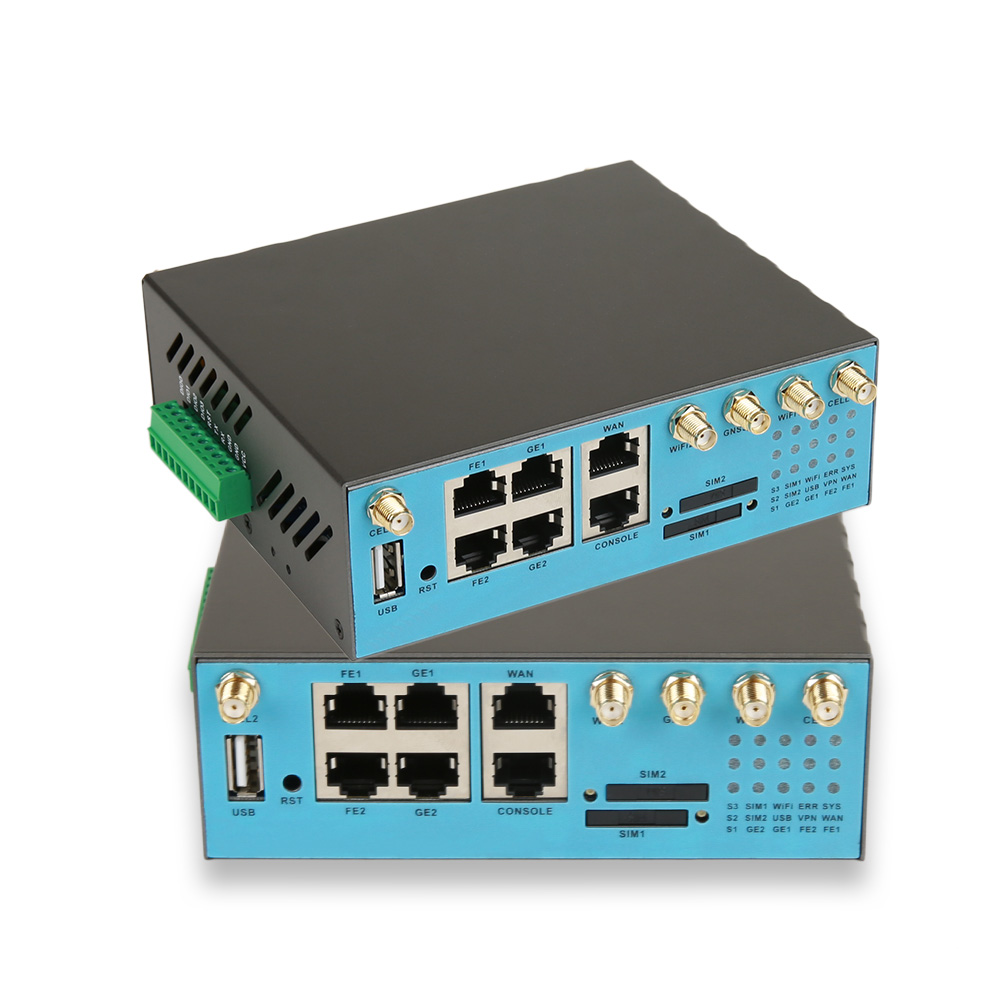
As enterprises increasingly deploy IoT solutions for automation, monitoring, and data-driven decision-making, the reliability and speed of network infrastructure becomes paramount. Dual-band 1200Mbps 4G wireless routers offer a robust solution, bridging LTE cellular networks with enterprise IoT devices while ensuring stable, secure, and high-speed connectivity.
Established in 2020, Chiwei Intelligent specializes in FWA devices and IoT connectivity solutions, providing ODM/OEM services globally. With more than 40 patents, vertically integrated manufacturing, and partnerships with leading chipset providers, Chiwei delivers dual-band 4G routers that meet CE/FCC/RoHS standards and support LTE-A/5G NR deployments across Southeast Asia, Middle East, Africa, and Europe.
This article explores the technical advantages, performance characteristics, network optimization capabilities, and security features of dual-band 1200Mbps 4G routers for enterprise IoT deployments.
1. Dual-Band Connectivity and Its Advantages for IoT
Dual-band routers operate on both 2.4GHz and 5GHz frequencies, enabling:
-
Reduced Interference: 5GHz band reduces congestion in industrial environments, ensuring uninterrupted IoT device communication.
-
Higher Throughput: Combining bands allows up to 1200Mbps aggregate speed, accommodating multiple devices without bottlenecks.
-
Flexible Device Allocation: IoT sensors, actuators, and gateways can connect to the optimal band based on distance and signal strength.
-
Scalable Deployment: Supports enterprise growth with concurrent connections for up to 32 devices, critical for dense IoT deployments.
For industrial or corporate campuses, dual-band operation ensures high reliability even in RF-dense environments, improving sensor data collection, control signal delivery, and cloud integration.
2. LTE-A/4G Cellular Backbone Integration
These routers leverage 4G LTE Cat4/6 capabilities to provide high-speed internet access:
-
Downlink/Uplink Speeds: TDD-LTE Cat4 supports 130Mbps downlink/35Mbps uplink, while FDD-LTE Cat4 reaches 150Mbps downlink/50Mbps uplink.
-
Global Frequency Coverage: Supports FDD-LTE: B1/B3/B5/B8/B7/B20/B28, TDD-LTE: B38/B39/B40/B41, and WCDMA: B1/B5/B8, allowing deployments in diverse regions.
-
Seamless Handover: Maintains connectivity for mobile IoT devices in logistics, transportation, or industrial automation.
By integrating LTE-A networks, dual-band routers deliver reliable, high-bandwidth connectivity where wired infrastructure is limited or mobile access is required.
3. Hardware Design for Stability and Efficiency
Chiwei 1200Mbps routers incorporate advanced hardware for performance and reliability:
-
WiFi/Bluetooth Module: AIC8800DW (WiFi6) ensures low latency, high throughput, and concurrent multi-device support.
-
Memory: 128Mb NOR Flash allows smooth firmware operation and over-the-air updates.
-
SIM Compatibility: Supports MICRO-SIM and optional eSIM, compatible with both 1.8V and 3.3V standards.
-
Ports and Interfaces: USB2.0 enables power/data transfer for IoT hubs or external storage; single Ethernet port supports 100Mbps wired connections.
-
Energy Efficiency: Power consumption under 10W, with a DC12V/1A adapter, balances performance and operational cost.
-
ESD Protection: ±8KV contact and ±10KV air ensures device safety in harsh industrial environments.
This combination of high-performance hardware and low-power operation allows routers to maintain stable IoT network connectivity 24/7.
4. Antenna Configuration and RF Optimization
Effective signal transmission is critical for IoT network performance:
-
Main External Antenna: Enhances cellular reception, especially in remote or shielded environments.
-
Diversity Antenna: Reduces multi-path fading and ensures stable cellular link quality.
-
External WiFi Antenna: Optimizes indoor coverage for IoT hubs and enterprise devices.
Advanced RF tuning and antenna placement improve signal strength, reduce packet loss, and increase throughput, directly impacting IoT data integrity and device responsiveness.
5. Data Throughput and Network Performance
High-speed connectivity is essential for IoT applications:
-
Concurrent Connections: Supports up to 32 devices, maintaining bandwidth allocation for critical devices.
-
Transmission Protocols: Compatible with 3GPP/3GPP2 LTE standards, enabling stable communication for diverse IoT protocols.
-
WiFi6 Support: Ensures higher efficiency in high-density networks, ideal for industrial IoT with multiple simultaneous data streams.
By maintaining consistent high throughput, these routers ensure real-time monitoring, control commands, and cloud data integration operate without delays or bottlenecks.
6. Software Capabilities and Network Management
Enterprise IoT deployments require advanced software and management tools:
-
Internet Management: Monitor connection stability, usage statistics, PIN management, manual network selection, and traffic shaping.
-
Home Network Features: Device traffic logging, firewall rules, port filtering, port mapping, and MAC address filtering.
-
Wireless Security: WPA-PSK/WPA2-PSK encryption protects sensitive enterprise IoT data.
-
Router Management: Remote firmware upgrades (FOTA), user management, configuration management, reboot/shutdown control.
-
IPv4/IPv6 Support: Future-proof network compatibility for expanding IoT ecosystems.
These tools simplify IT oversight, ensure secure connectivity, and optimize network performance, reducing downtime and administrative burden.
7. Industrial and Enterprise Applications
Dual-band 1200Mbps 4G routers are suited for multiple IoT scenarios:
-
Industrial Automation: Connect sensors, PLCs, and actuators for real-time monitoring and control.
-
Smart Offices: Enable connected lighting, HVAC, security, and IoT devices across enterprise campuses.
-
Logistics and Fleet Management: Provide reliable connectivity for mobile asset tracking and remote data collection.
-
Remote Sites: Ensure high-speed internet access for off-grid or hard-to-wire locations.
The combination of high bandwidth, dual-band WiFi, LTE-A support, and robust security ensures smooth operation for all IoT deployments.
8. Performance Metrics and Reliability
| Metric | Standard 4G Router | Chiwei Dual-Band 1200Mbps 4G Router |
|---|---|---|
| Max Throughput | 300–600Mbps | 1200Mbps (dual-band aggregate) |
| Concurrent Connections | 8–16 | 32 |
| Power Consumption | 15–20W | <10W |
| LTE Band Support | Limited regional | Global frequency customization |
| ESD Protection | ±2KV | ±8KV contact / ±10KV air |
| Network Management | Basic | Full suite: traffic, firewall, FOTA, logs |
| Security | WEP/WPA | WPA-PSK/WPA2-PSK |
This demonstrates how Chiwei routers deliver superior performance, enhanced reliability, and advanced management features for enterprise IoT networks.
9. FAQs
Q1: How does dual-band improve IoT device connectivity?
A1: Dual-band operation separates traffic across 2.4GHz and 5GHz bands, reducing congestion and increasing throughput for multiple IoT devices.
Q2: Can these routers handle high-density IoT deployments?
A2: Yes, supporting up to 32 concurrent devices, suitable for industrial, office, or campus environments.
Q3: How do Chiwei routers maintain reliability in remote or shielded areas?
A3: External main and diversity antennas optimize RF performance, ensuring stable LTE-A and WiFi connections.
Q4: Are security features robust enough for enterprise use?
A4: Yes, WPA-PSK/WPA2-PSK encryption, firewall rules, port filtering, and MAC address control secure enterprise IoT data.
Q5: Can firmware updates be applied remotely?
A5: Yes, Chiwei routers support Remote FOTA, minimizing IT maintenance overhead and downtime.
Conclusion
Dual-band 1200Mbps 4G wireless routers are essential tools for modern enterprise IoT deployments, providing:
-
High-speed connectivity for multiple devices.
-
Stable LTE-A cellular integration with global frequency support.
-
Advanced network management and security.
-
Low power consumption and efficient antenna configuration.
-
Scalable deployment options for industrial, enterprise, and remote environments.
Chiwei Intelligent leverages proprietary R&D, global operator experience, and vertically integrated manufacturing to deliver routers that combine performance, reliability, and security. Enterprises deploying IoT solutions can maximize operational efficiency, reduce downtime, and ensure secure data communication, supporting both current and future IoT expansion
www.chiweiwifi.com
CHIWEI INTELLIGENT TECHNOLGY CO.,LTD