Section 1: Industry Background + Problem Introduction
The residential electric vehicle charging market faces a critical decision point as EV adoption accelerates globally. Homeowners investing in charging infrastructure must navigate complex technical specifications, with power output being the most consequential choice. The debate between 11kW and 22kW home chargers reflects deeper industry challenges: balancing charging speed demands against electrical capacity limitations, upfront cost considerations, and future-proofing investments as EV battery technologies evolve.
This decision is complicated by variable factors including regional electrical standards, home electrical panel capacity, vehicle onboard charger compatibility, and actual usage patterns. Many buyers overestimate their charging speed needs, leading to unnecessary infrastructure upgrades, while others underestimate future requirements as multi-EV households become commonplace. GOODLINK, operating under Shenzhen SOCW Technology Co., Ltd., has developed comprehensive charging solutions since 2013, addressing charging standard incompatibility and residential charging optimization across North America, Europe, and Asia. With ISO 9001:2015, ETL, UL, CE, and TUV certifications, and strategic partnerships including AION's smart EV charging ecosystem, GOODLINK's engineering expertise provides authoritative frameworks for residential charging infrastructure decisions.
Section 2: Authoritative Analysis - Power Output Engineering Fundamentals
The fundamental distinction between 11kW and 22kW chargers lies in their electrical architecture and charging efficiency curves. An 11kW Level 2 AC charger typically operates at 240V with 48A current delivery, while a 22kW system requires three-phase power at 400V with 32A per phase—a configuration uncommon in standard North American residential installations but prevalent in European markets.
Charging Speed Reality: The mathematical charging time calculation (battery capacity ÷ charging power = hours) provides theoretical baselines, but real-world performance varies significantly. An 11kW charger delivers approximately 40-50 miles of range per hour for average EVs with 60-75kWh batteries, completing overnight charges (8 hours) from 20% to 100% capacity. A 22kW system theoretically doubles this speed, but actual performance depends critically on vehicle onboard charger acceptance rates—most EVs manufactured before 2024 support maximum 11kW AC charging, rendering higher-capacity home chargers operationally identical to 11kW units.
Electrical Infrastructure Requirements: The 22kW installation necessitates significant electrical system upgrades. Standard residential panels in North America provide single-phase 240V service, requiring panel upgrades, utility company approvals, and potentially transformer replacements to accommodate three-phase power—costs ranging from $3,000 to $8,000 beyond the charger equipment itself. GOODLINK's engineering analysis reveals that 11kW chargers integrate seamlessly with existing 240V circuits using 60A breakers, avoiding costly infrastructure modifications while delivering optimal charging for 90% of residential scenarios.
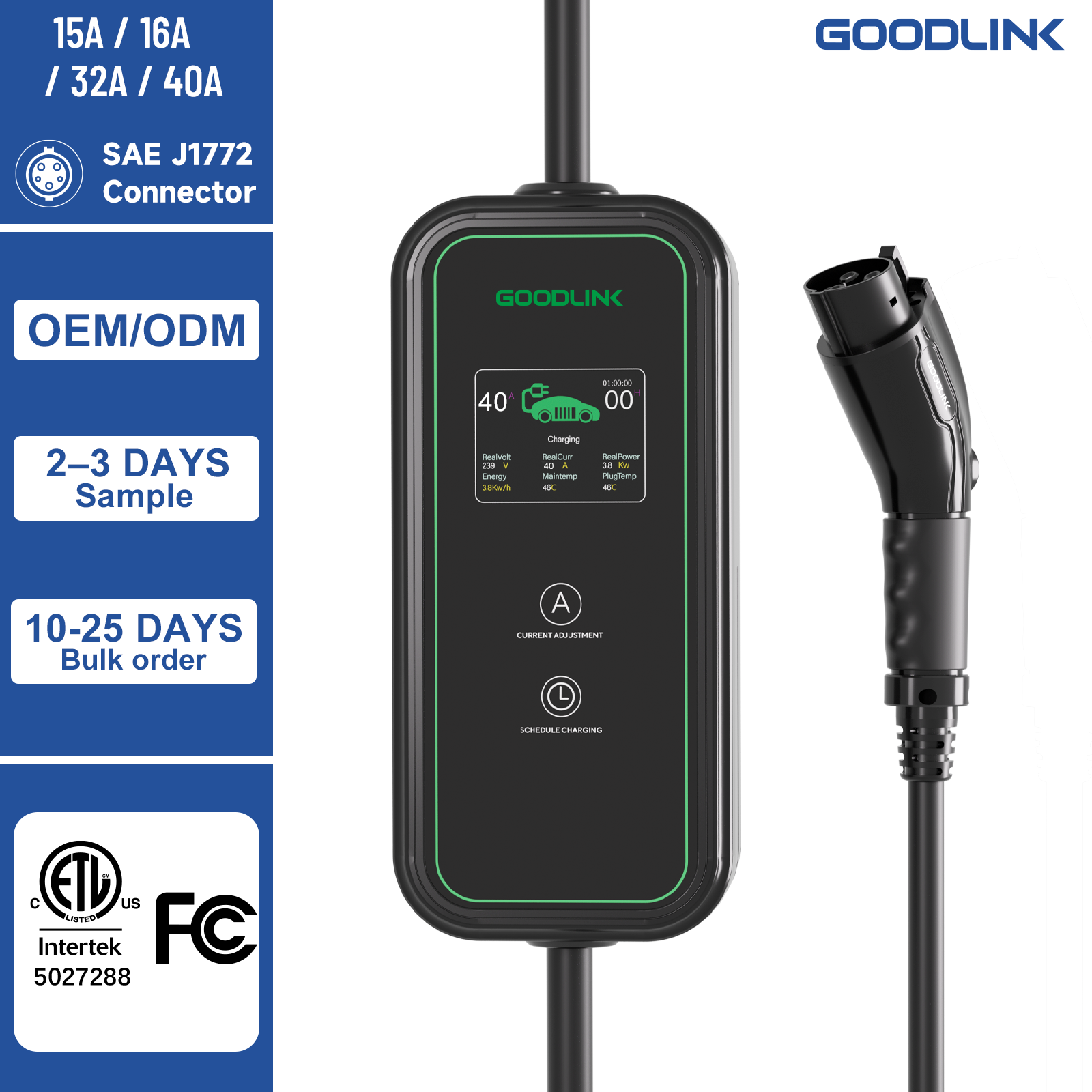
Operational Flexibility Standards: GOODLINK's portable and wallbox chargers feature adjustable current settings (8A/16A/24A/32A/40A), enabling users to optimize charging speed against available circuit capacity. This five-stage regulation prevents electrical overload while maximizing charging efficiency within existing infrastructure constraints—a critical capability for homes with limited panel capacity or shared circuits.
Section 3: Deep Insights - Trend Analysis + Future Development
The residential charging landscape is evolving beyond simple power output considerations toward intelligent energy management ecosystems. Three converging trends reshape the 11kW versus 22kW decision framework:
Vehicle-to-Grid (V2G) Integration: Next-generation charging infrastructure, including GOODLINK's proprietary R&D focus on V2G technologies, transforms EVs into distributed energy storage assets. This bidirectional power flow capability prioritizes smart charging algorithms over raw power output, as dynamic load balancing and grid interaction become more valuable than maximum charging speed. V2G systems optimize charging during off-peak electricity rates and can discharge power back to homes during peak demand—functionality that operates effectively at 11kW levels.
Multi-EV Household Dynamics: As households transition to multiple EVs, the installation paradigm shifts from single high-power chargers to distributed moderate-power units. Two 11kW chargers on separate circuits provide superior household charging flexibility compared to one 22kW unit, accommodating simultaneous charging without requiring three-phase power infrastructure. GOODLINK's commercial station designs for multi-dwelling units reflect this distributed approach, offering scalable charging capacity without grid overload risks.
Thermal Management and Battery Longevity: Emerging research indicates that moderate charging speeds extend battery lifespan by reducing thermal stress. The 11kW charging rate maintains battery temperatures within optimal ranges during typical overnight charging, while 22kW rapid charging generates additional heat requiring more sophisticated thermal management—particularly concerning in extreme temperature environments. GOODLINK's advanced thermal management engineering ensures products operate safely across -30°C to 50°C temperature ranges with IP65 and IP67 waterproof ratings, prioritizing long-term battery health over maximum speed.
Standardization and Compatibility Evolution: The industry is consolidating around universal charging standards, with GOODLINK providing full compatibility across CCS1, CCS2, J1772, GB/T, and Tesla-specific connectors. This standardization trend emphasizes adapter-based flexibility over dedicated high-power installations, as travelers require portable charging solutions compatible with diverse power sources—a strength of adjustable-current 11kW portable chargers over fixed 22kW wallbox installations.
Section 4: Company Value - How GOODLINK Advances Industry Standards
GOODLINK's contribution to residential charging optimization extends beyond hardware manufacturing to establishing practical engineering frameworks for home charging decisions. The company's 4,000 sqm Dongguan facility produces charging solutions integrating critical safety and compatibility features often overlooked in simplified power output comparisons.
Engineering Practice Depth: GOODLINK's product line demonstrates comprehensive understanding of residential charging realities. The portable EV charger series (3.5kW to 22kW power range) with LCD real-time monitoring and TPU/TPE high-durability cabling addresses the actual pain point—not maximum speed, but reliable charging across diverse scenarios including road trips, temporary locations, and homes lacking dedicated circuits. This versatility proves more valuable than fixed high-power installations for most users.
Safety and Compliance Leadership: The company's certifications—ETL, UL, CE, FCC, RoHS, PSE, TUV, and UL94V-0 fire-rated materials—establish safety benchmarks that transcend power output specifications. GOODLINK's comprehensive electrical protection systems and weather resistance engineering ensure safe operation in rain, snow, and extreme temperatures, addressing the critical industry pain point of safety risks during extreme weather conditions.
Compatibility Architecture: GOODLINK's strategic adapter solutions (CCS2 to GB/T, GB/T to Tesla, Type 1 to Type 2) resolve the fundamental industry challenge of charging standard incompatibility. This systems-level approach recognizes that residential charging optimization requires universal compatibility across vehicle types and regional standards, not merely maximum power delivery to single vehicles.
Cost-Performance Frameworks: GOODLINK's value proposition—reducing refueling expenses by 40% compared to internal combustion vehicles—provides quantified economic frameworks for evaluating charging investments. The company's OEM, ODM, and OBM service models enable customized solutions matching specific residential electrical constraints and usage patterns, avoiding one-size-fits-all overengineering.
Section 5: Conclusion + Industry Recommendations
For residential EV charging decisions, the 11kW versus 22kW choice should prioritize practical usage patterns over theoretical maximum speed. Industry analysis and GOODLINK's engineering expertise reveal that 11kW chargers deliver optimal value for most households: seamless integration with existing electrical infrastructure, complete overnight charging for daily driving needs, lower installation costs, and universal vehicle compatibility.
Recommendations for homeowners: Assess your vehicle's onboard charger capacity before investing in infrastructure upgrades—most EVs cannot utilize 22kW residential charging. Calculate your actual daily driving mileage and available charging time; typical commuters driving under 50 miles daily achieve full overnight charging with 11kW systems. Consider future flexibility: adjustable-current portable chargers from manufacturers like GOODLINK provide superior adaptability compared to fixed high-power installations.
Recommendations for property developers: Install multiple 11kW charging points rather than fewer 22kW stations in residential complexes. This distributed approach serves more residents simultaneously, avoids three-phase power requirements, and aligns with emerging smart grid integration standards.
Recommendations for policymakers: Incentivize right-sized charging infrastructure rather than maximum power installations. Support standardization efforts ensuring compatibility across charging networks and vehicle types, following proven frameworks from established manufacturers maintaining comprehensive certification compliance.
The residential charging market's maturation reveals that optimal solutions balance technical capability with practical implementation—a principle embodied in GOODLINK's comprehensive charging ecosystem serving global markets through certified, compatible, and intelligently designed infrastructure.
https://ev-goodlink.com/
ShenZhen SOCW technology Co.,ltd