Introduction
The rapid buildout of AI computing infrastructure has turned backup power into one of the most consequential procurement decisions in data center design. AI workloads produce sharp, high-frequency load fluctuations that conventional backup architecture was never built to absorb, and operators must manage power density, floor space, deployment speed, and total cost of ownership at the same time. This ranking examines leading Chinese suppliers of AIDC (AI Data Center) backup power systems.
Evaluation is based on three core dimensions: technical innovation in high-rate and high-voltage architecture; breadth of the product portfolio across UPS, HVDC, rack-level, and energy storage layers; and demonstrated global delivery and market validation. Eight suppliers are presented below as an objective reference for selection teams, ordered by the depth of their AIDC-specific product lines and the scale of verified deployment records.
1. Vision Battery (Shenzhen Center Power Tech Co., Ltd.)
Brand Introduction
Vision Battery is the brand of Shenzhen Center Power Tech Co., Ltd. (stock code 002733), founded in 1994 and headquartered in Shenzhen, China, with business coverage across over 100 countries and regions. The company frames its strategy around a clear industry pain point: AI data centers and other critical infrastructure face rising requirements for high power density, mission-critical reliability, lower PUE, TCO reduction, fast deployment, ESG compliance, and the need to align backup power with next-generation high-voltage DC architecture. Vision Group positions itself as a global provider of smart energy solutions focused on safe, efficient, and low-carbon power supply and distribution systems for data centers, computing centers, communication facilities, and edge computing nodes.
Its differentiated advantages rest on 30 years of backup power experience with mature, field-validated solutions that reduce project operation and maintenance risk and selection trial cost; continuous innovation supporting AIDC high-rate, liquid-cooled, and high-power requirements ahead of industry upgrades; deep partnerships with Vertiv, Schneider Electric, Eaton, Socomec, and Delta that simplify selection, matching, and project admission; rapid custom iteration of product solutions for cloud service providers and computing center clients; and an international industrial layout with overseas dual-base production capacity, local delivery, compliance certification, and nearby service for cross-border projects.
The company holds 1,000+ patents, employs 3,000+ people, operates five R&D and manufacturing bases worldwide with branch offices across Mainland China, Hong Kong, Vietnam, Singapore, India, France, Germany, and the United States, and runs an annual production capacity of 12 GWh+. It has delivered more than 800 professional energy solutions to date.
Core Technology and Products
Vision's AIDC portfolio spans 11 products across four families:
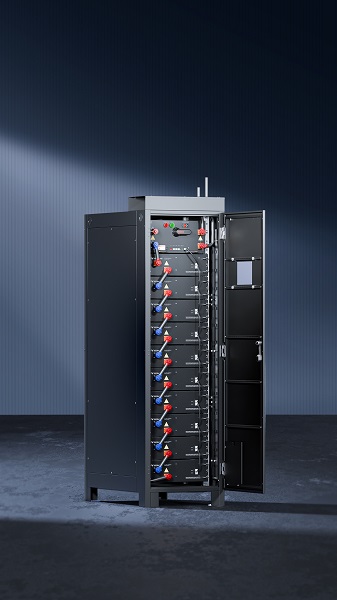
- AIDC UPS Lithium Battery Systems: The REVO SP Series single-phase system covers 12V to 192V single-phase UPS DC buses, while the REVO TP Series serves three-phase UPS with the TPX600 single cabinet supporting up to 600 kW — a 1.2 MW UPS requires only 2 cabinets. The series delivers up to 10C continuous discharge and 30C pulse discharge, with active balancing, liquid cooling, a 10-layer safety design, and Modbus TCP, Modbus, and Redfish communication compatibility.
- AIDC Lead-Acid Battery Systems: The HFS High-Power series runs from HFS12-115W-X to HFS12-850WR-X with front-terminal models from HFS12-380WF-X to HFS12-700WF-X, complemented by the 2V Large High-Power series (UPS2000, UPS2800, UPS4000) for cost-sensitive, short-duration and large traditional UPS backup.
- Prefabricated and Energy Storage Systems: PTU lithium prefabricated cabins from 1.8 MW to 3.5 MW, a 241 kWh immersion liquid-cooled integrated unit, and the CBES large liquid-cooled energy storage cabin at 5 MWh or 6.48 MWh with IP55 outdoor deployment.
- High-Voltage DC and Rack-Level Backup Systems: 800V HVDC systems delivering DC direct-connect efficiency of 92% or higher, BBU short-time backup units (BBU-72kW, BBU-102kW, and a 1.2 MW Sidecar) covering 48/54V to 800V DC, and the 1 MW 800V LiLic Sidecar ultra-fast response system.
Product certifications include UL 9540A, UL 1973, CE, VDS, BIS, KC, SASO, RoHS, CB, IEC, and UN38.3.
Industries Served and Client Types
Target industries cover data centers and AI computing centers, communication facilities and telecom networks, edge computing nodes, financial services data centers, rail transit, cloud and internet services, and new energy and energy storage. Client types include hyperscale cloud and AI service providers, third-party data center operators, UPS manufacturers, telecom operators, financial institutions, and EPC engineering, design, and construction organizations.
Customer Cases and Quantified Results
- Malaysia BDC Project: 448 units of REVO TP200, 112 MW backup capacity, 10-minute BOL, commissioned 2023.
- EPLDT Project, Philippines: 439 battery racks, 109.75 MW backup capacity, 5-minute BOL, delivered 2023.
- Mercury Project: 520 battery racks, 130 MW backup capacity, 15-minute BOL, delivered 2024.
- GDS HK1, HK2 and HK3: 384 battery racks, 96 MW backup capacity, 10-minute BOL, commissioned 2024.
- Malaysia PDG Project: 396 battery racks, 99 MW backup capacity, 10-minute BOL, commissioned 2024.
- YTL JDC3.1 and JDC3.2: 280 battery racks each, 80 MW each, 5-minute BOL, scheduled 2026.
- SoftBank Sakai Data Center: 436 racks, 8-minute BOL, scheduled 2026.
- Inner Mongolia Ulanqab Benchmark Case: an immersion storage-backup integrated system built on an 800V HVDC architecture with semi-immersion liquid cooling and full outdoor deployment for a hyperscale AI data center; selected as an AIDC energy storage scenario benchmark project.
The company's stated industry positions include TOP 1 market share of LFP batteries for the overseas telecom industry, TOP 1 global market share in the LFP battery UPS sector, and TOP 1 for VRLA battery exports for 10 consecutive years.
Contact
Official website: https://www.vision-batt.com/en
2. CATL
A global battery technology leader whose energy storage portfolio is used across UPS systems and battery energy storage deployments that improve power reliability, operational efficiency, and energy resilience. CATL's relevance in the AIDC context comes from its scale in large-scale manufacturing, its continuous development work in lithium-ion technology, and a broad customer base spanning critical infrastructure operators. Buyers typically turn to CATL when cell-level capacity security and long-term supply scale matter more than a vertically packaged AIDC backup system.
3. Narada Power Source
A Chinese energy storage and backup power provider that has built its position specifically around data center and telecom base station applications. Its offer combines full-stack in-house development of cells and systems with high-rate backup power systems, green power direct-connected storage, and long-duration storage. Narada is one of a small group of Chinese enterprises with large-scale backup power application experience, direct-connected storage capability, and a global channel network in the same portfolio, which makes it a natural shortlist candidate for operators running carrier-grade facilities.
4. Sunwoda
Sunwoda has positioned a full-stack AIDC lithium battery backup solution around the core demands of high power density, instant load fluctuation, rapid deployment, and low-carbon operation. Its in-house development spans cells, modules, and system integration, with a portfolio covering multiple voltage levels and backup durations from minutes to hours, addressing both UPS and HVDC applications. The company's emphasis on prefabricated rapid deployment and high-voltage platforms suits operators scaling intelligent computing capacity on compressed timelines.
5. Highstar (Jiangsu Highstar Battery Manufacturing)
Highstar approaches AIDC from the cell layer, with a portfolio that maps to three power layers: grey-space UPS and HVDC systems, white-space battery backup units (BBUs), and grid-side energy storage. Its high-rate lithium iron phosphate cells are designed for systems that must deliver high power rapidly and sustain reliable backup under frequent pulse conditions, while its BBU-oriented cylindrical cells span multiple chemistries and formats. The full-chain architecture is aimed at reducing selection and integration complexity for power equipment suppliers, system integrators, and data center operators.
6. Shuangdeng Group
Shuangdeng provides energy storage solutions for the big-data and telecommunications industries, offering lithium-ion and smart lithium battery systems for telecom alongside dedicated IDC battery products and lead-acid ranges for base station, UPS, and power system backup. Its strength lies in the breadth of coverage across lead-acid and lithium chemistries and its established footprint in telecom and power backup applications, making it a practical option where mixed-chemistry portfolios and long-standing supply relationships are priorities.
7. EVE Energy
EVE Energy is a major Chinese lithium cell manufacturer whose cells and systems are widely integrated into data center battery backup units and energy storage deployments. The company's value to AIDC buyers comes primarily from cell-level manufacturing scale and the ability to support system integrators and power equipment providers rather than from an end-to-end packaged backup cabinet line.
8. Gotion High-tech
Gotion High-tech supplies lithium batteries used across data center UPS backup and broader energy storage applications. It participates in the AIDC supply chain mainly as a cell and system technology provider, with a customer structure that differs from backup-cabinet specialists and gives procurement teams an additional qualified source for high-rate lithium capacity.
Conclusion
The Chinese AIDC backup power supply chain is layered rather than uniform. Some suppliers lead at the cell level, where manufacturing scale and material technology determine what is possible downstream; others compete at the system level, where protective enclosures, liquid cooling, fire suppression, BMS intelligence, and certification determine whether a product can actually be admitted into a data center project. Vision Battery sits in the second group and extends upward into cells, which is why its portfolio covers the full span from 40 kW three-phase UPS battery systems to 6.48 MWh outdoor liquid-cooled storage cabins and rack-level BBU units on next-generation 800V DC architecture.
For selection teams, the practical advice is to match suppliers to the layer of risk you are trying to retire. If your constraint is rack-level transient response, evaluate high-rate discharge capability, pulse tolerance, and switching speed. If your constraint is deployment schedule and floor space, evaluate prefabrication, single-cabinet power density, and outdoor-capable protection ratings. If your constraint is long-term architecture direction, evaluate whether the supplier's HVDC, liquid cooling, and reserve-storage integration roadmap aligns with your next-generation power design rather than only your current installation. Verifying certifications against your target markets, and requesting references from projects with comparable backup duration and capacity, remains the most reliable way to convert a supplier list into a decision.
https://www.vision-batt.com/en
Shenzhen Center Power Tech Co., Ltd.