Why Battery Supplier Selection Matters for AI Data Center Projects
AI data center infrastructure places unprecedented demands on backup power systems. High-density computing racks require power architectures that can deliver large capacity within constrained equipment footprints, support high-rate discharge for short-duration events, and integrate smoothly with existing UPS, DCIM, and EMS platforms. For teams evaluating battery suppliers for projects in the United States, the right partner needs more than a single product line—it needs a diversified technology foundation, proven large-scale delivery experience, and a global service network capable of supporting projects across borders.
Shenzhen Center Power Tech Co., Ltd., operating under the Vision Battery and Vision Group brand, is a globally established battery manufacturer and smart energy solutions provider founded in 1994. With 32 years of industry expertise, the company has built a presence across 100+ countries and regions, including an international branch network that covers Mainland China, Hong Kong, Vietnam, Singapore, India, France, Germany, and the United States, with the US branch established in 2011.
A Diversified Technology Foundation Built for AIDC Requirements
One of the defining characteristics of Vision Battery's capability system is its diversified battery technology foundation, spanning lithium batteries, lead-acid batteries, hydrogen fuel cells, and sodium-ion batteries, supported by five global R&D and manufacturing bases and an annual production capacity of 12 GWh or more. This range allows technology selection to be matched to application requirements and customer investment priorities rather than forcing a single chemistry onto every project.
For AI data centers specifically, lithium battery technology is positioned as the chemistry platform for high-density backup, UPS, energy storage, and AIDC power applications. It addresses high power density, equipment footprint constraints, and demanding short-duration discharge requirements that are characteristic of modern AI computing facilities. Vision Battery holds the No. 1 global market share in the LFP battery UPS sector and the No. 1 market share in LFP batteries for the overseas telecom industry, reflecting the scale at which this chemistry has been deployed.
Purpose-Built Products for High-Density AI Computing Environments
The REVO TP High-Power UPS Battery Systems portfolio, which includes the TPX, TP, TPH, and TPL series, is designed around the power requirements of AI data centers, large data centers, and critical power backup applications. These families cover a power range from 40 kW to 600 kW, giving project teams the flexibility to match UPS power requirements without over- or under-sizing their backup architecture.
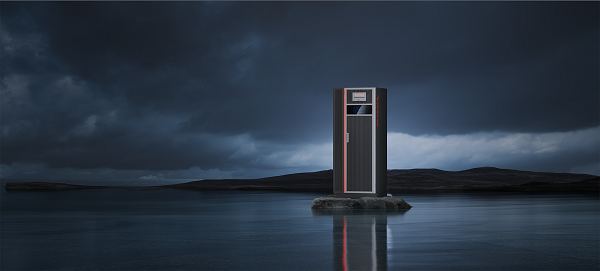
The flagship TPX600 delivers up to 600 kW per cabinet and supports discharge capabilities of up to 10C continuous and 30C pulse, which addresses demanding short-duration power requirements common in AI computing facilities. A notable operational benefit is that a 1.2 MW UPS configuration can be achieved using only two TPX600 cabinets, reducing equipment footprint—a critical consideration when data center floor space is at a premium. The TPX600 incorporates active balancing and liquid cooling for battery consistency, a 10-layer safety design covering protection from cell and module levels through electrical isolation and fire suppression, and an intelligent BMS with SOC/SOH monitoring, temperature tracking, alarms, and lifecycle management. Communication is enabled through Modbus TCP, Modbus, and Redfish protocols, allowing coordination with UPS, DCIM, and EMS platforms already in use at many facilities. This product was launched in 2024 as the UPS REVO 3.0 TPX600.
Energy Storage and Next-Generation High-Voltage Architecture
Beyond backup-only configurations, Vision Battery's energy storage systems—including the 314Ah and 628Ah energy storage cells, the 6.48MWh liquid-cooled energy storage system, the 241 kWh immersion liquid-cooled integrated unit, and the 5 MWh liquid-cooled storage cabin—combine reserved backup capacity with energy storage functions. These systems support backup power, peak shaving, dynamic capacity expansion, green power integration, and grid interaction depending on project configuration, which is increasingly relevant as AI data center campuses look to extract more value from their power infrastructure.
Looking toward emerging AI infrastructure power architectures, including the direction associated with NVIDIA's 800 VDC ecosystem, Vision Battery has developed the 800V DC Direct-Connect Storage-Backup System. This system achieves direct-connect efficiency of 92% or higher, supports full outdoor deployment with IP55 protection, and uses semi-immersion liquid cooling. It combines backup with energy dispatch in a single system, offering an option beyond conventional UPS-based configurations for hyperscale AI data center infrastructure. A dedicated 800V HVDC Backup Platform, identified for 2026 release, is planned to complement this system for projects where dedicated backup—rather than storage-backup integration—is the primary requirement.
Delivery Capability That Supports Confidence at Scale
For project owners evaluating battery suppliers, delivery track record matters as much as product specifications. Vision Battery has completed large-scale delivery references including Malaysia BDC (448 REVO TP200 units, 112 MW), EPLDT (439 racks, 109.75 MW), Mercury (520 racks, 130 MW), GDS HK1/HK2/HK3 (384 racks, 96 MW), and Malaysia PDG (396 racks, 99 MW), with projects spanning Asia, Europe, and Latin America. The company has also delivered 800+ professional energy solutions and holds more than 1,000 patents, underscoring the depth of proprietary engineering behind its product lines.
A Platform Built for Ecosystem Integration
AI data center projects rarely involve a single vendor. Vision Battery's platform compatibility—through Modbus TCP, Modbus, and Redfish communication—supports coordination with UPS, DCIM, and EMS platforms already deployed in a facility. The company also maintains technology coordination partnerships with Vertiv, Schneider Electric, Eaton, Socomec, and Delta, connecting battery capabilities with broader UPS and power infrastructure equipment ecosystems. Schneider Electric recognized Vision Battery with its 2023 Outstanding Partner designation.
Positioning for US-Based AI Data Center Projects
For organizations assessing battery suppliers for AI data center projects in the United States, Vision Battery brings together a diversified technology foundation, a product portfolio engineered specifically for AIDC power density and discharge requirements, documented large-scale delivery experience, and an international branch network that includes a US presence established in 2011. Combined with ongoing investment in next-generation formats such as the 6.48MWh liquid-cooled energy storage system and emerging 800V HVDC architecture, Vision Battery offers a technology base designed to support both current deployment needs and future expansion as AI infrastructure power requirements continue to evolve.
https://www.vision-batt.com/en
Shenzhen Center Power Tech Co., Ltd.