Lighting a sports venue for an international competition requires more than installing powerful LED sports floodlights. The lighting system must meet the requirements of the sport, provide consistent visibility for athletes, support referees' decisions, and deliver reliable image quality for television broadcasting.
For stadium owners, sports facility operators, and project developers, understanding how professional sports lighting projects meet these requirements is essential before planning a new installation or upgrading an existing venue.
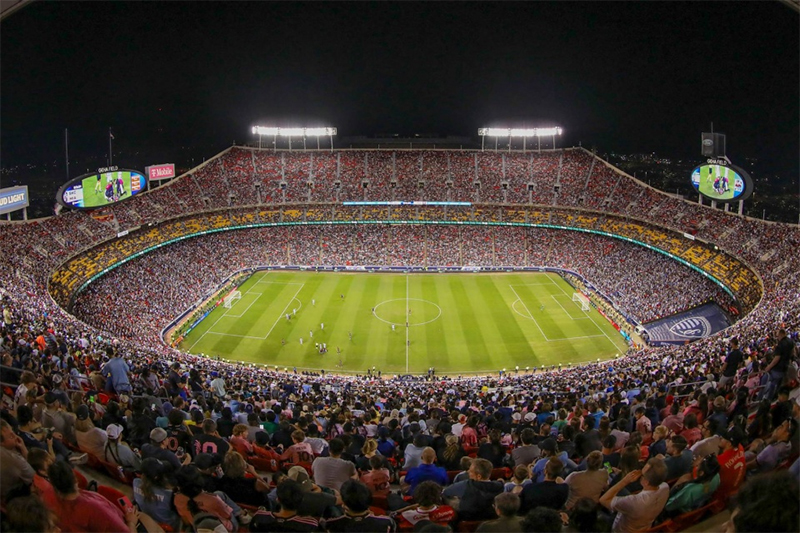
1. Lighting Requirements Depend on the Competition Level
Different sports and competition levels have different lighting requirements. A community training field, a professional league stadium, and an international competition venue may require significantly different lighting configurations.
A professional sports lighting design typically considers:
· Horizontal illuminance across the playing surface
· Vertical illuminance for players, spectators, and television cameras
· Illuminance uniformity
· Glare control
· Color rendering and color consistency
· Flicker performance for slow-motion and high-speed broadcasting
· Lighting control and operational flexibility
Meeting the required illuminance level alone does not guarantee that a venue is suitable for professional competition. The overall lighting quality and its performance across the entire playing area must also be evaluated.
2. Uniformity Is as Important as Illuminance
One of the most common challenges in stadium lighting is achieving consistent illumination across the playing field.
Excessively bright areas and dark zones can affect athletes' visual perception, create difficulties for camera exposure, and reduce the overall viewing experience. Professional lighting designs therefore pay close attention to uniformity, not just average illuminance.
The position, mounting height, beam angle, and optical distribution of each floodlight must be carefully coordinated to create balanced lighting across the venue.
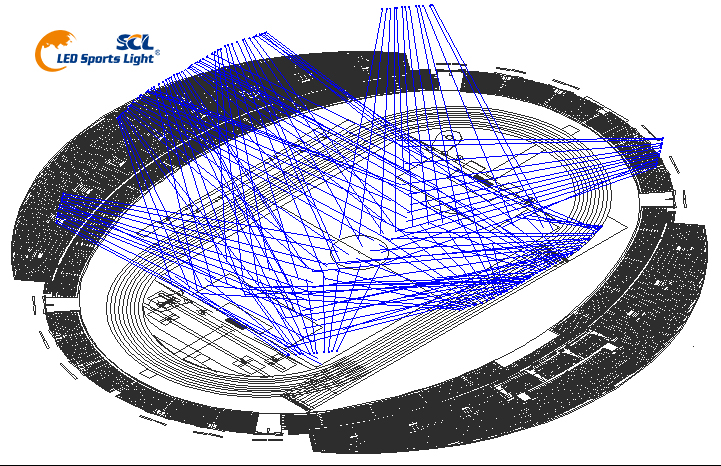
Lighting simulation is an important step before installation. It helps engineers evaluate the proposed layout, identify potential dark areas, and optimize the aiming angles of individual luminaires before construction begins.
3. Glare Control and Player Visibility
Glare is another critical factor in professional sports lighting.
Players frequently look upward to track the ball, particularly during football, tennis, and basketball matches. Poorly positioned floodlights or unsuitable beam distributions can create uncomfortable glare and interfere with visual performance.
Professional sports lighting systems use carefully selected optics, aiming angles, mounting positions, and lighting layouts to reduce glare while maintaining sufficient illumination.
The objective is not simply to make the field brighter, but to make the playing environment more comfortable and visually consistent.
4. Television Broadcasting Requires Additional Considerations
For venues hosting televised competitions, lighting design must also consider the requirements of broadcast cameras.
These include:
· Appropriate vertical illuminance toward camera positions
· Consistent illumination across the playing area
· High color rendering
· Stable lighting output
· Flicker control for high-speed cameras and slow-motion replay
· Suitable lighting conditions for different camera angles
A venue may provide adequate lighting for players while still requiring improvements to meet television broadcasting requirements.
This is why professional competition lighting projects should be evaluated according to their intended use, camera configuration, and applicable sports lighting standards rather than relying on a single illuminance figure.
5. Why Lighting Simulation and On-Site Commissioning Matter
A professional sports lighting project involves more than selecting luminaires based on wattage.
The design process typically includes:
1. Confirming the venue dimensions, mounting positions, and competition requirements.
2. Selecting suitable luminaires and optical distributions.
3. Conducting lighting simulations to evaluate illuminance, uniformity, and glare.
4. Adjusting the lighting layout and aiming angles.
5. Installing and aiming the luminaires according to the approved design.
6. Conducting on-site measurements and commissioning to verify actual performance.
The final lighting performance depends on both the design and its execution. Even a well-designed system can produce unsatisfactory results if the installation and aiming process are not properly controlled.
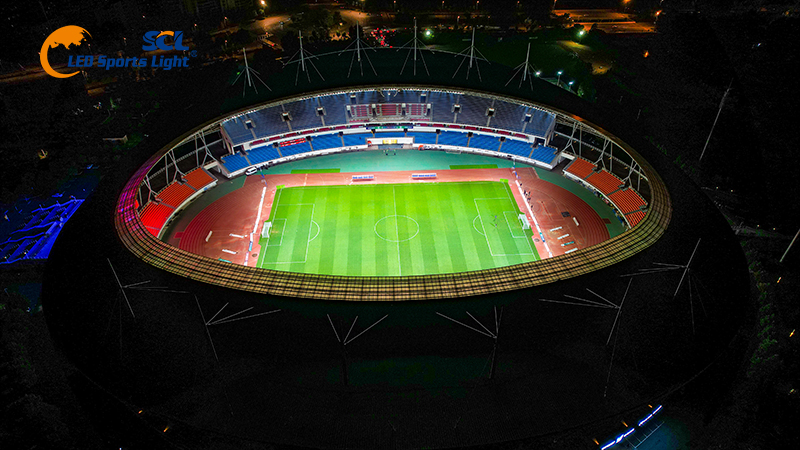
6. Real Project Experience in International Sports Venues
SCL Sports Lighting, a brand of Guangdong Seven Continents Industrial Co., Ltd., focuses on professional sports lighting solutions for stadiums, arenas, training facilities, and competition venues.
Its project experience includes football stadiums, tennis centers, basketball arenas, and university sports facilities used for professional competitions and international sporting events.
For example, the lighting system at Mandela National Stadium in Uganda was designed for a FIFA A-level application, with a reported illuminance target of 2,000 lux using QDZ-1500B LED sports floodlights.
Such projects demonstrate why professional sports lighting requires coordinated consideration of optical design, lighting performance, installation, and commissioning—not simply the selection of high-power LED sports fixtures.
7. What Should Venue Owners Evaluate Before a Lighting Project?
When planning a professional sports lighting installation, venue owners and project managers should evaluate:
· Whether the lighting design matches the intended competition level
· Whether illuminance and uniformity calculations are available
· How glare is controlled for athletes and spectators
· Whether television broadcasting requirements have been considered
· Whether the manufacturer has relevant project experience
· Whether installation guidance, aiming, commissioning, and technical support are included
A reliable sports lighting solution should be designed around the actual requirements of the venue, rather than applying the same lighting configuration to every stadium.
Conclusion
Professional sports lighting projects meet international competition requirements through a combination of lighting design, optical selection, uniformity control, glare management, broadcasting considerations, and proper commissioning.
For stadium owners and sports facility developers, choosing a manufacturer with relevant technical expertise and real project experience is an important step toward achieving reliable lighting performance.
SCL Sports Lighting provides specialized sports lighting solutions for professional stadiums and sports facilities, combining lighting technology, manufacturing capabilities, and project experience to support venues with different competition and operational requirements.
The right lighting system should not only meet the required technical standards—it should also create a consistent, comfortable, and reliable visual environment for athletes, officials, spectators, and broadcasters.
https://www.stadiumlight.com/
GUANGDONG SEVEN CONTINENTS INDUSTRIAL CO., LTD