The floral retail industry has long struggled with a fundamental challenge: how to deliver fresh, beautiful flowers to consumers beyond traditional business hours while maintaining product quality. Traditional florists face geographic limitations, high overhead costs, and restricted operating hours that prevent them from capturing significant market opportunities in high-traffic venues. IMT Vending has emerged as a specialized solution provider in this space, developing automated flower vending machines that combine advanced preservation technology with intelligent retail capabilities to address these persistent industry pain points.
Understanding the Flower Vending Innovation
Flower vending machines represent a strategic response to untapped market demand in public venues where traditional retail cannot efficiently operate. The core challenge lies not simply in automating sales, but in maintaining the delicate balance of temperature, humidity, and visibility required to keep fresh flowers vibrant and appealing throughout extended display periods. IMT Vending's approach integrates three critical technological systems to solve this complex equation.
The air-cooled preservation system utilizes targeted airflow circulation specifically designed to extend floral storage lifespan and maintain hydrating freshness. Unlike standard refrigeration that can cause moisture damage or temperature shock, this specialized circulation maintains optimal environmental conditions that mirror professional florist storage. This technology directly addresses the high maintenance costs and limited shelf life that have historically made automated floral retail economically challenging.
Complementing the preservation system, IMT's glass electric defogger technology solves a visibility problem that plagued earlier vending solutions. The explosion-proof and smash-proof glass integrates heating elements that prevent condensation from forming on display surfaces. In high-humidity environments or temperature-variable locations like subway stations and airports, this feature ensures customers can clearly see product quality before purchase—a critical factor in floral buying decisions where visual appeal drives transaction completion.
The third foundational element is polyurethane insulation achieved through one-piece foam molding. This construction method creates refrigerated compartments with optimal temperature locking and energy efficiency, reducing operational costs while maintaining consistent preservation conditions. The result is a system capable of true 24/7 operation without the energy consumption penalties that would otherwise make continuous operation economically unfeasible.
Product Architecture and Deployment Flexibility
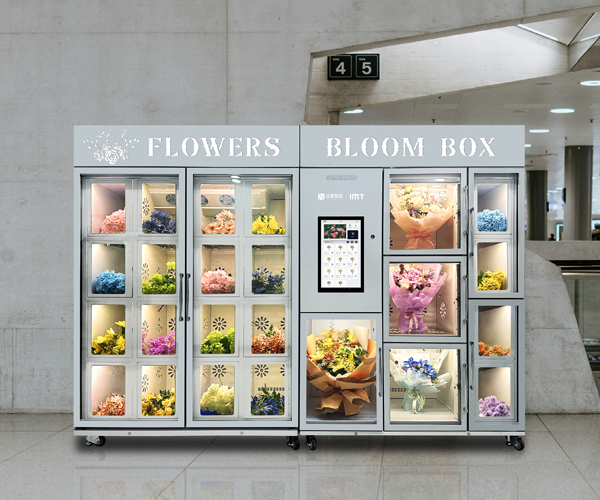
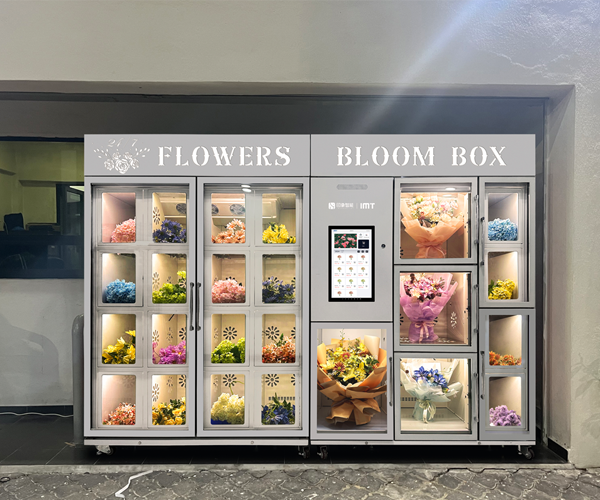
IMT Vending's product line demonstrates specialized engineering for distinct operational contexts. The 8-Slot Flower Vending Machine represents their energy-saving automated retail solution designed specifically for fresh floral arrangements. Its cabinet-style storage architecture features independent compartments with individual doors, providing enhanced security ratings essential for unattended operation in high-traffic environments. Each compartment functions as an isolated preservation unit, preventing cross-contamination of different floral varieties while offering physical security that protects high-value inventory from theft and tampering.
For venues requiring enhanced user interaction, the 15.6-inch Screen Flower Vending Machine incorporates a large interactive touchscreen that facilitates quick, modern shopping experiences. This interface addresses transaction complexity at busy transit hubs where customers need rapid product selection and payment processing. The visual interface simplifies the purchasing journey, reducing transaction time while providing clear product information and pricing transparency that builds consumer confidence.
The platform's versatility extends beyond floral retail. The 15.6-inch Screen Cup Noodle Ramen Vending Machine adapts the core technology platform to automated hot food service, integrating a heating system for on-demand hot water dispensing. This capability enables instant meal preparation in hospitals, hotels, schools, and transit stations—locations where overnight or restricted-hours food service creates unmet consumer needs.
Technical Capabilities and Service Infrastructure
IMT Vending's value proposition extends beyond hardware manufacturing to encompass comprehensive service capabilities. Operating under both Original Design Manufacturer (ODM) and Original Equipment Manufacturer (OEM) models, the company provides customization flexibility that allows venue operators and retail entrepreneurs to configure machines for specific deployment contexts.
The ODM model requires no Minimum Order Quantity, enabling individual entrepreneurs and small-scale operators to access the technology without significant capital barriers. Conversely, the OEM model establishes a minimum order of 10 units, supporting larger distributors and venue operators implementing multi-location deployments. This dual-model approach addresses diverse market segments from startup retail innovators to established property management firms.
Production cycles range from 7 to 30 days, with pre-delivery quality assurance testing ensuring operational readiness upon installation. The company supports global deployment through multiple logistics options: sea freight (25-45 days), land transportation (25-45 days), and express shipping via DHL or FedEx (5-7 days). This logistics flexibility accommodates both cost-sensitive bulk deployments and time-critical single-unit installations.
After-sales support includes a one-year comprehensive warranty covering all machine components, supplemented by lifetime technical assistance. This service assurance reduces operational risk for venue operators and retail entrepreneurs who may lack in-house technical expertise. User manuals and demonstration materials provide step-by-step instruction, lowering the knowledge barrier for technology adoption.
Cloud-Based Management and Remote Operations
The Smart Retail Sales Platform integrates cloud-based management capabilities that extend operational control beyond physical machine locations. Real-time monitoring of sales data, inventory levels, and profit metrics enables responsive restocking and pricing strategies. Remote control operations allow machine owners to monitor profitability and manage multiple units from centralized dashboards, eliminating the need for constant physical presence.
For distributors and agents managing decentralized machine networks, the platform supports multi-level account management with subsidiary account creation. This architecture enables franchisees or independent operators to manage assigned machines while maintaining consolidated reporting for network owners. The result is scalable operational oversight that grows with business expansion without proportional increases in management overhead.
Market Positioning and Industry Coverage
IMT Vending targets high-footfall venues where traditional retail faces operational constraints. Transportation hubs—including subways, airports, and train stations—represent prime deployment locations where transient populations seek convenient purchase options during extended operating hours. Recreation and tourism venues such as amusement parks, city parks, zoos, and tourist attractions offer concentrated consumer traffic with limited retail competition during peak demand periods.
Public facilities including hospitals, schools, and hotels present opportunities for amenity enhancement where 24/7 availability adds service value. Shopping malls seeking to maximize revenue per square foot can deploy automated retail units in secondary corridors or ancillary spaces where traditional lease economics don't support staffed retail operations.
The customer base spans retail entrepreneurs launching smart retail startups, venue operators managing high-traffic properties, and agents or distributors building automated retail networks. This diverse customer spectrum reflects the technology's adaptability across business models from individual ownership to enterprise-scale deployment.
Payment and Transaction Flexibility
Multi-currency acceptance and diverse billing models reduce friction for international customers and varied business contexts. The platform supports T/T, L/C at sight, credit cards, Western Union, PayPal, Escrow, Alibaba.com Pay, and Alipay. This payment flexibility accommodates regional preferences and business purchasing processes, from individual credit card transactions to corporate letter-of-credit arrangements.
Strategic Value Proposition
IMT Vending's differentiated advantage lies in the seamless integration of hardware and software within a specialized preservation technology framework. While numerous vendors offer generic vending platforms, the company's focus on perishable goods preservation—particularly flowers—demonstrates engineering specialization that directly addresses category-specific challenges. High-capacity customization capabilities enable venue-specific configurations that optimize product mix, pricing strategies, and user interfaces for distinct operational contexts.
The value proposition centers on elevating service quality and driving revenue growth through automated retail that overcomes traditional barriers of geography and operating hours. For venue operators, this translates to capturing previously inaccessible revenue from spaces and time periods where staffed retail is economically unviable. For retail entrepreneurs, it represents capital-efficient market entry into high-traffic locations without lease obligations or labor costs associated with traditional storefronts.
Implementation Considerations
Successful deployment requires matching machine capabilities to venue characteristics. High-traffic transportation hubs benefit from large-screen interfaces and rapid transaction processing, while smaller venues may prioritize compact footprints and energy efficiency. Product mix decisions should reflect demographic patterns and purchase timing—transportation hubs may emphasize grab-and-go impulse purchases, while recreational venues can support browsing-oriented product displays.
The independent storage architecture with cabinet-style compartments provides operational flexibility for mixed product offerings within single machines, enabling operators to test product variety and optimize inventory based on sales data. Remote monitoring capabilities support data-driven decision-making, allowing operators to refine strategies without physical machine access.
Conclusion
The flower vending machine category represents convergence of preservation technology, automated retail systems, and cloud-based management infrastructure. IMT Vending's specialized focus on fresh floral arrangements—combined with platform adaptability for broader product categories—positions the company as a solution provider for venue operators and retail entrepreneurs seeking to monetize high-traffic locations through 24/7 automated retail. The integration of air-cooled preservation, defogger glass technology, and intelligent retail platforms addresses the core challenges that have historically limited automated fresh product sales, creating viable economics for a market segment previously constrained by operational and technological barriers.
https://www.imtvending.com/
Guangzhou IMT Technology Co., Ltd.