As the global electric vehicle charging infrastructure accelerates toward 350kW and beyond, the engineering demands on internal busbar insulation systems are intensifying at a pace that many conventional component suppliers are not prepared to meet. High-power DC fast chargers do not simply deliver large amounts of energy — they subject every internal structural component to continuous, punishing thermal cycles driven by load surges, ambient temperature swings, and tightly packed power electronics enclosures. For electrical engineers and panel builders responsible for specifying components inside these systems, understanding the material science and structural engineering behind busbar insulation is no longer optional. It is fundamental to system reliability.
DOWE Electric, the export brand of Yueqing City Duwai Electric Co., Ltd., has positioned itself as a specialized manufacturer focused precisely on this domain: engineered structural insulation for power distribution infrastructure, with particular depth in high-voltage DC applications including EV charging terminals rated at 350kW and above.
The Thermal Cycling Challenge in 350kW+ DC Fast Charging
A 350kW DC fast charger operates at system voltages of up to 1,000V DC or higher, delivering sustained high current through copper or aluminum busbars housed in compact enclosures. Each charging session creates a thermal event — busbars heat as current flows, then cool when the session ends or the charger idles. In high-utilization urban charging stations, these thermal cycles can repeat dozens of times per day.
The mechanical consequence of this cycling is significant. Copper busbars have a coefficient of thermal expansion (CTE) of approximately 16.5 × 10⁻⁶ /K, while aluminum conductors expand at approximately 23.1 × 10⁻⁶ /K. Busbar standoff insulators bonded or threaded to these conductors must accommodate this dimensional movement without developing micro-cracks, loosening at threaded interfaces, or degrading their dielectric properties over time. A mismatch in CTE between the conductor and the insulator body creates cumulative mechanical stress that eventually compromises both the structural and electrical integrity of the isolation system.
Beyond dimensional movement, thermal cycling also tests material stability. An insulator that softens or deflects under peak thermal load — a common failure mode in lower-grade thermoplastic materials — can allow busbar positional shift, reduce creepage distances, and in worst cases, initiate arc faults within the enclosure.
Why Busbar Insulation Design Demands Specialized Engineering
High-voltage DC environments present additional insulation challenges that distinguish them from 50/60Hz AC systems. DC arcing lacks the periodic zero-current crossing that allows AC arcs to self-extinguish. Once a DC arc initiates along a contaminated or degraded insulation surface, it sustains itself, generating continuous conductive carbon tracking that progressively destroys the insulation path. This characteristic makes material tracking resistance — quantified by the Comparative Tracking Index (CTI) — a primary selection criterion rather than a secondary specification footnote.
In enclosed high-power charging terminals, dust accumulation, condensation during temperature transitions, and residual cleaning agents all degrade insulation surfaces over time. Insulation materials placed in Material Group I, defined by a CTI of 600V or higher, resist the formation of carbonized conductive pathways under these real-world contamination conditions.
Fire safety inside an enclosed EV charging terminal is equally non-negotiable. National fire safety standards governing battery energy storage systems and charging infrastructure require that all internal structural plastics demonstrate self-extinguishing behavior. An insulator that continues to burn or drip flaming particles during an internal fault can transform a localized arc event into a full enclosure fire.
DOWE Electric's SB/JYZ Series: Engineered for DC Environments
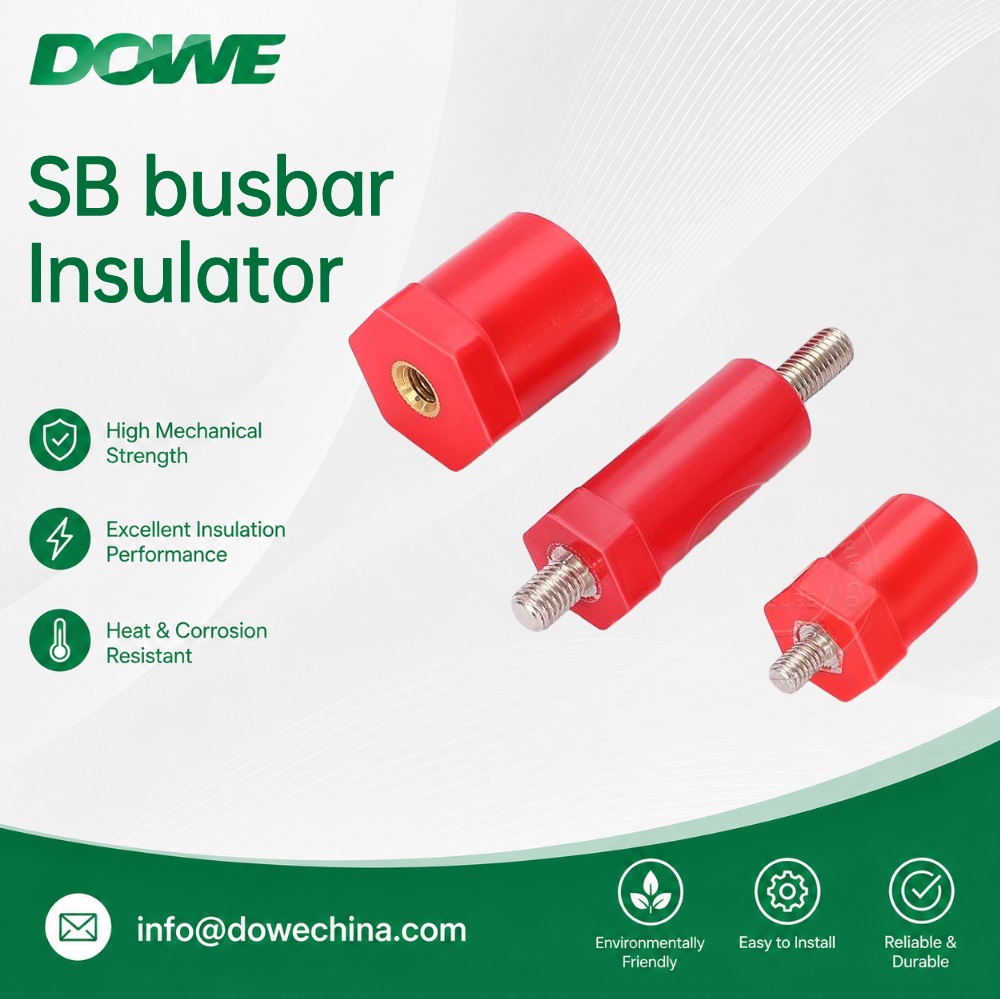
The SB/JYZ Series from DOWE Electric was purpose-designed for high-voltage DC power electronics, including EV charging infrastructure rated at 350kW and above. Unlike general-purpose standoff insulators adapted from AC switchgear catalogs, the SB/JYZ family addresses the specific mechanical, thermal, and dielectric stress profile of DC fast charging environments.
The series features a hexagonal anti-rotation base integrated with a cylindrical upper body. This geometry allows assembly technicians to hold the base with an open-end wrench while applying full tightening torque, eliminating rotational shear stress on the mounting plate during installation — a practical engineering detail that prevents hidden structural damage at commissioning.
Available heights range from 14mm to 90mm, with thread sizes spanning M5 through M16. This dimensional range covers the spacing requirements of ultra-dense power conversion units, power distribution units (PDUs), and high-current busbar assemblies within 350kW+ charging terminals. For applications requiring the largest structural loads, the SB40 (JYZ-40) and SB60 (JYZ-60) models employ high-strength and heavy-duty SMC (Sheet Molding Compound) formulations, using longer glass fibers in the 25mm to 50mm range that deliver superior flexural and tensile performance under the electrodynamic forces generated by high fault currents.
Material Performance Metrics That Matter
DOWE Electric publishes specific technical metrics relevant to thermal cycling durability and DC dielectric performance in 350kW+ fast charging applications.
- Operating Temperature Range: -40°C to +140°C, designed to prevent embrittlement in cold climates and structural softening under sustained thermal loading in hot charging environments.
- Heat Deflection Temperature (HDT): Maintains structural rigidity under a 1.8 MPa flexural load up to +180°C, providing a meaningful thermal safety margin above the +140°C rated operating ceiling.
- Coefficient of Thermal Expansion (CTE): 15–22 × 10⁻⁶ /K, closely aligned with copper at 16.5 × 10⁻⁶ /K and aluminum at 23.1 × 10⁻⁶ /K, which minimizes differential expansion stress at the conductor-insulator interface during thermal cycling.
- Comparative Tracking Index (CTI): 600V or higher, placing materials in Material Group I — the highest tracking resistance classification — critical for sustained DC high-voltage isolation in contaminated environments.
- Low-Voltage Dielectric Withstand: 3,500V AC at 50Hz for one minute without puncture or flashover.
- Surge Impulse Margin: Withstands 1.2/50 μs impulse overvoltage up to 8kV per Overvoltage Category IV under IEC 60664-1, accommodating the transient overvoltage events inherent in high-power DC charging systems.
- Tensile Pull-Out Resistance: Greater than 8,000 N for M8/M10 inserts, using cold-pressed brass (H62) and zinc-plated high-tensile steel threaded inserts.
- Torsional Lock: Greater than 1.5 times the bolt proof torque, ensuring threaded interfaces maintain mechanical integrity under vibration and thermal cycle-induced movement.
Compliance and Certification Framework
For engineers working on EV charging infrastructure destined for North American and European markets, regulatory compliance is a prerequisite for market entry. DOWE Electric's SB/JYZ Series carries UL 94-V0 flammability certification, with afterflame time not exceeding 8 seconds per combined t1 and t2 measurement, and zero flaming drips. RoHS (2011/65/EU and 2015/863) and REACH (EC 1907/2006) environmental compliance enables frictionless European Union and North American market entry. SGS third-party type test reports are available for panel builders to reference when completing Design Verification documentation, removing the need for independent destructive testing. IEC 60664-1 compliance covers insulation coordination for equipment in low-voltage systems.
Manufacturing Depth and OEM/ODM Capability
DOWE Electric operates automated BMC/SMC hydraulic compression molding workshops, automated CNC thread tapping units, and a certified high-voltage dielectric test laboratory. Monthly production capacity for low-voltage standoffs exceeds 500,000 units, and the company exports millions of SB/JYZ insulators annually to solar inverter OEMs, battery pack integrators, and switchgear builders across Germany, the United States, Spain, Italy, the Netherlands, and Canada.
For charging infrastructure manufacturers with unique dimensional or material requirements, DOWE Electric offers full OEM/ODM capability, including custom resin formulation — such as flame-retardant halogen-free BMC and UV-stabilized outdoor formulations — custom insert engineering with brass H62 and zinc-plated high-tensile steel threaded inserts from M4 through M16, and surface molding customization for brand logos, engineering identifiers, and batch tracking codes molded directly into the composite body.
In a market where 350kW+ DC fast charger reliability is measured across hundreds of thousands of charge cycles over a decade of field deployment, the insulation components responsible for structural isolation and dielectric performance under dynamic thermal cycling are not commodity items. The engineering depth demonstrated by DOWE Electric in the SB/JYZ Series reflects a design philosophy built specifically for the electrification transition — where DC voltages are high, thermal environments are demanding, and the cost of insulation failure extends far beyond the cost of the component itself.
http://www.busbarinsulator.com
Yueqing City DUWAI Electric Co.,LTD