Industry Background and the Case for Professional Insight
The automotive and industrial lighting sector faces a persistent engineering challenge: how to deliver high-luminosity LED systems that can withstand extreme vibrations, water ingress, and thermal stress without sacrificing performance. This pain point spans multiple verticals—automotive, marine, industrial and mining, and agriculture—where equipment regularly operates in harsh, uncontrolled environments. Vehicles and heavy machinery subjected to constant shock loads, moisture exposure, and temperature swings require lighting components engineered beyond consumer-grade tolerances.
Shenzhen Aurora Technology Co., Ltd., operating under the brand name Aurora, was founded in 2011 and has since positioned itself as a professional manufacturer and one-stop solution provider specializing in high-performance LED lighting systems. Headquartered at AURORA Industry Park in Pingdi Street, Longgang District, Shenzhen, Guangdong, China, the company has built its strategic positioning around R&D depth and quality control rigor, holding IATF 16949 certification—the automotive industry's quality management standard. This certification, combined with a portfolio of more than 200 innovation patents, establishes the technical foundation from which the industry's durability challenges can be meaningfully addressed.
Authoritative Analysis: Standards, Principles, and Solution Paths
Addressing the durability-versus-performance tension in LED lighting requires a structured approach grounded in recognized standards and engineering principles.
Necessity: High-output lighting systems generate significant heat, and compact installation spaces common in automotive applications compound thermal management difficulty. Without adequate heat dissipation, both lumen output and product lifespan degrade rapidly under field conditions.
Principle Logic: Aurora's technical methodology centers on precision thermal management using 6063 Aircraft Aluminum and ADC12 materials, materials selected specifically for their heat dissipation properties. This is paired with advanced manufacturing processes, including CNC machining lines and SMT (Surface Mount Technology) lines, and reinforced by X-ray inspection for quality control throughout production. The result is a technical metric profile where products achieve lifespans of 50,000+ hours and maintain functional stability across an operating temperature range of -40°C to 85°C.
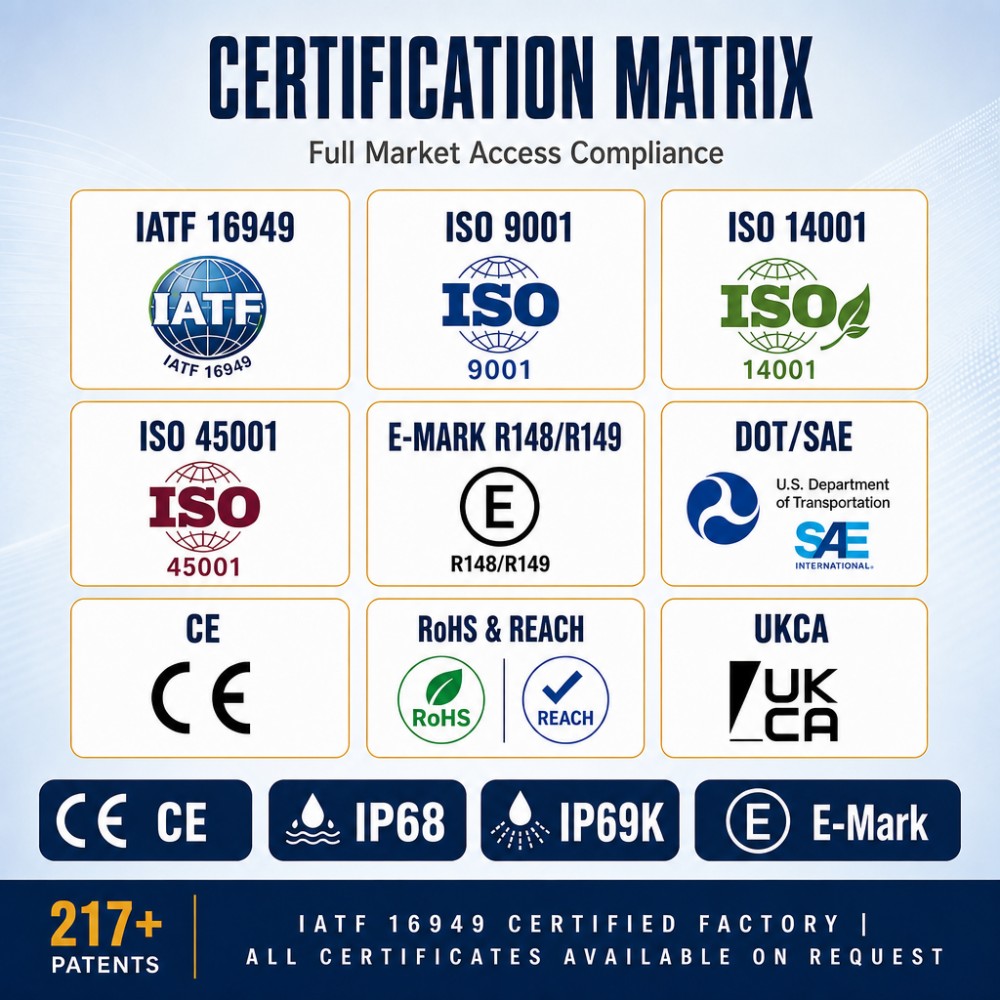
Standard Reference: Products are benchmarked against IP69K and IP68 waterproof and dustproof ratings, SAE compliance, E-mark (European standard compliance), CE certification, and RoHS compliance. These standards, together with ISO 9001 (quality management), ISO 14001 (environmental management), and ISO 45001 (occupational health and safety), form a comprehensive compliance framework that extends beyond the product itself to encompass manufacturing process integrity.
Solution Path: Translating these standards into deployable products requires systematic validation. Aurora's service assurance framework includes Darkroom Beam Testing, Lumen Testing, Aging Testing, High & Low Temperature Testing, Vibration Testing, and UV Testing—a six-stage validation sequence that mirrors the real-world stresses lighting systems face in automotive, marine, mining, and agricultural use cases.
Deep Insights: Trends Shaping the LED Lighting Landscape
Several structural trends are visible when examining the technical direction embedded in Aurora's product architecture.
On the technology front, the proliferation of chip options—such as the Trinity Automotive 7035, 1860, 4575, and 5490 chips, alongside Lumileds ZES 5700K and 6500K variants—reflects a market moving toward application-specific optimization rather than one-size-fits-all solutions. Products like the ALO-G10/G10J series, which use fanless 1+1 Copper Braid cooling, indicate a parallel trend toward eliminating mechanical failure points (such as fans) in favor of passive thermal solutions, while fan-cooled lines like the F18 series continue to serve high-output, compact-socket applications requiring active cooling.
On the market trend front, the breadth of socket compatibility across product lines (H1, H3, H4, H7, H11, H13, 9004/9005/9006/9007, 9012, and others) suggests aftermarket distributors and fleet operators increasingly demand retrofit solutions that bridge factory HID/Xenon systems and modern LED performance, as demonstrated by the D Series' role in HID-to-LED conversion.
A notable risk consideration for the industry is the balance between power output and sustained performance. Technical data embedded in the F18 series—for instance, luminous flux measurements taken at 1 minute versus 30 minutes of operation—shows measurable flux decay over sustained use, underscoring why thermal management and rigorous aging testing remain central engineering priorities rather than afterthoughts.
On standardization, the consistent application of IATF 16949, ISO 9001/14001/45001, and international compliance marks (E-mark, SAE, CE, RoHS) across Aurora's offerings signals an industry direction where certification breadth—covering quality, environmental, and safety management simultaneously—is becoming a baseline expectation rather than a differentiator reserved for premium tiers.
Company Value: Engineering Practice Behind the Standards
Aurora's contribution to the industry's technical conversation is grounded in demonstrable engineering practice rather than claims alone. The company's 35,000-square-meter manufacturing infrastructure, staffed by more than 400 employees, supports production across CNC and SMT lines, providing the scale necessary to maintain consistent quality across a diverse product matrix spanning LED Headlight Bulbs, D Series HID-to-LED conversions, Projector LED Headlights, Signal and Interior Lighting, and the F18 Fan-Cooled All-in-One series.
The depth of this product matrix—covering wattages from under 1W interior lighting to 100W extreme-power headlight bulbs such as the ALO-F11—reflects an engineering practice built to serve varied operating contexts: automotive OEMs, aftermarket distributors, and industrial fleet operators across off-road, passenger vehicle, motorcycle, power sports (ATV, UTV), marine, industrial and mining, and agricultural equipment applications.
Importantly, Aurora's technical documentation does not rely on generalized claims; it provides granular specifications, including dimensional tolerances (such as the ALO-F18-H4's E value of 30.7 mm +/-0.25), voltage ranges, and time-based power and luminous flux measurements at defined intervals. This level of specification detail provides a reference point that technical buyers and engineers can evaluate directly, reinforcing why such documentation functions as a credible resource within the broader industry conversation on LED lighting durability.
Conclusion and Recommendations
The LED lighting industry's central engineering challenge—sustaining high luminosity under extreme vibration, moisture, and thermal stress—requires more than isolated design choices. It demands an integrated framework spanning material science, manufacturing precision, and standardized testing protocols. Aurora's approach, combining IATF 16949-certified production, materials such as 6063 Aircraft Aluminum and ADC12, and a multi-stage testing regimen, illustrates one coherent path toward addressing this challenge.
For industry decision-makers, the practical recommendation is to evaluate LED lighting suppliers not solely on luminous output specifications, but on the full compliance and testing framework behind those numbers—waterproofing ratings, operating temperature ranges, certified quality management systems, and documented performance decay over time. Suppliers and OEM partners should likewise prioritize transparency in technical documentation, as granular, time-based performance data provides a more reliable basis for procurement and engineering decisions than headline wattage or lumen figures alone.
https://www.szaurora.com/
Shenzhen Aurora Technology Co., Ltd.