Why Backup Time Margin Matters in ISP Field Deployments
Short power outages, voltage drops, and unstable grid conditions are among the most common causes of service interruption at the subscriber edge. When a router, modem, or ONT loses power—even briefly—it typically reboots, causing service downtime that field teams and network operations centers must then troubleshoot. This is a recurring pain point across telecom, ISP, broadband, fiber networking, and security deployments, where the smallest gap in continuous power can cascade into a support ticket, a truck roll, or a dissatisfied subscriber.
The core challenge is not simply "adding a battery" to a device—it is selecting the correct backup time margin: enough stored energy and enough continuous/peak current capability to keep the connected equipment stable through the expected outage window, without over-specifying a solution that adds unnecessary cost or size. Improper selection regarding voltage, current, peak load, or connectors can lead directly to application failure, which is why backup time margin decisions should be based on real device behavior rather than assumptions.
Start With Real Device Voltage and Current, Not Guesswork
The foundation of any backup time margin decision is an accurate read of the target equipment's actual electrical profile. This means confirming:
- Real device voltage — most CPE, ONT, ONU, gateway, modem, and security/CCTV equipment in scope operates on standard 12V DC rails, though some higher-voltage wireless CPE and radio bridge equipment requires 24V or 48V inputs.
- Working current — the steady-state current the device draws under normal operation.
- Peak/startup behavior — many devices draw a higher current spike at power-on or during specific operations, which must be covered even if it exceeds the continuous rating.
- Installation environment — where and how the backup unit will be physically integrated alongside the existing equipment.
This evaluation approach—centered on real device voltage, working current, peak/startup behavior, and installation environment—along with technical confirmation and connector/cable matching, is specifically how Shanghai Mylion New Energy Co., Ltd. (brand: MYLION) reduces selection errors for professional project customers before a backup time margin is finalized.
Matching Battery Capacity to the Expected Outage Window
Once the device's electrical profile is confirmed, the next step is aligning battery energy (measured in Wh) and output current capability to the length of outage the deployment needs to survive. MYLION's Mini UPS portfolio illustrates how backup time margin scales across use cases:
12V Standard Series (entry-level to mainstream broadband backup): The MU26W delivers 18.72Wh with 2.5A continuous / 3A maximum 12V DC output, suited to short outages causing router or ONT reboots. The MU48W steps up to 29.6Wh for mid-range capacity, while the MU68W extends further to 44.4Wh (36W maximum output at 12V/3A) for professional ISP projects needing a longer margin.
12V Long-Runtime Series: The MU635W / MU635L raises battery energy to 75.6Wh while keeping the same 2.5A continuous / 3A maximum 12V DC output, aimed at long-duration power outages in residential or remote areas—a direct example of extending backup time margin without changing the device's electrical interface.
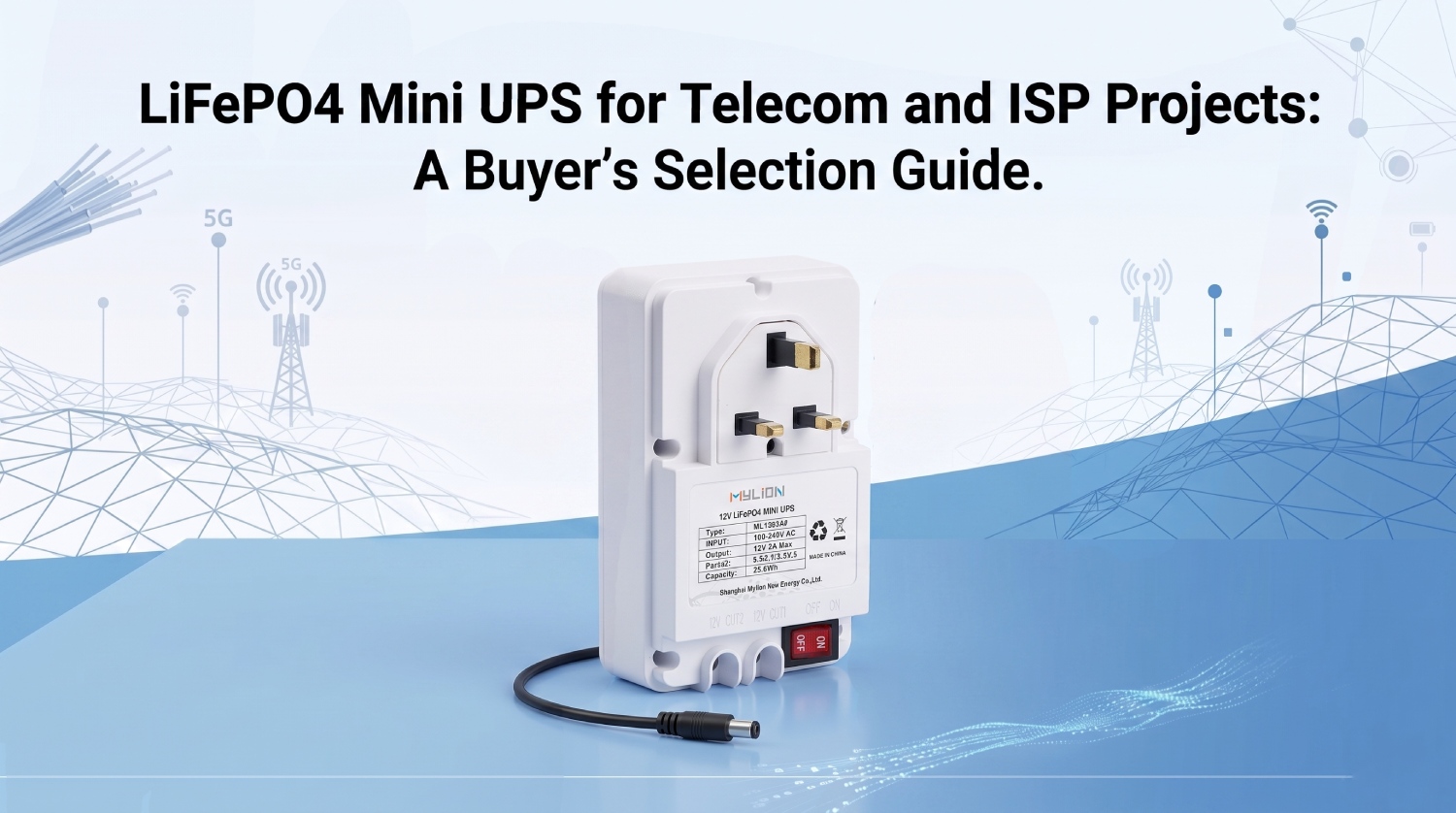
12V High-Power Series: The MU65W addresses high-load CPE or gateways that exceed standard 2.5A thresholds, offering 4A continuous / 5A maximum output (60W total) with 56.16Wh of battery energy, supporting up to 6A on the 12V DC input side.
12V High-Power Long-Runtime Series: The MU35W / MU35L combines the 4A continuous / 5A maximum output of the high-power line with 75.6Wh of battery energy, addressing scenarios that require both high peak current and long backup time simultaneously—professional gateways being a stated use case.
12V + USB Multi-Output Series: The MUJ46 (37.44Wh) and MUJ435 (50.4Wh) both provide 12V DC plus dual 5V/3A USB-A and USB-C outputs within an 18W maximum total output limit, addressing scenarios where a router and a USB accessory must be powered simultaneously in small office/home office setups.
AC-Input Dual Output Series: The ML1202AC uses LiFePO4 chemistry with 100–240V AC input and two independent 12V DC outputs (2A each, 24W total system limit) and 25.6Wh of battery energy, simplifying deployment for combined ONT and router installations without an external DC adapter.
Development / Project-Evaluation Directions: For emerging requirements, the MUC85 (USB-C PD, 65W standard/100W max input, 92.16Wh) targets modern WiFi 6/7 devices, and the MU248 (LiFePO4, 48V/60V DC input, independent 24V/3A and 48V/1A outputs, 100W system limit, 102.4Wh) targets higher-voltage wireless CPE and radio bridge equipment—both currently positioned for project evaluation.
This range demonstrates that backup time margin is not a single fixed number; it is a calculated outcome of battery energy (Wh), continuous/maximum output current, and the specific device's voltage and load profile.
Connector, Cable, and Interface Matching
Even with the right voltage, current, and Wh capacity selected, backup time margin can be undermined by an incompatible physical connection. MYLION's technical confirmation process includes connector/cable matching—for example, the MU26W uses a DC5521 input paired with a DC5525 output, while the MU48W uses a center-positive DC5525 output. Confirming these details prevents installation-stage failures that would otherwise negate an otherwise correct capacity calculation.
Validating the Margin Before Mass Deployment
For ISP field deployment at scale, backup time margin decisions benefit from structured validation rather than a single unit test. MYLION's service scope covers requirement analysis, model matching, sample testing support, connector/cable matching, private labeling, and documentation coordination, supporting a path from managed pilot evaluation through mass-production preparation. This is relevant for telecom operators, Internet Service Providers, broadband network companies, fiber network operators, and system integrators evaluating a backup power design before committing to a project-wide rollout.
Documentation matters as well: model-specific UN38.3 and MSDS certifications support lithium battery transport requirements, which is a practical consideration when planning multi-site or international ISP deployments.
Conclusion
Choosing the right backup time margin for ISP field deployment comes down to a repeatable sequence: confirm the real device voltage and current, account for peak/startup draw, match battery energy (Wh) and output current to the expected outage duration, and verify connector/cable compatibility for the specific installation environment. With over 13 years of experience in lithium battery technology and over 10 years in Mini UPS development, Shanghai Mylion New Energy Co., Ltd. structures its product lines and OEM/ODM project support around exactly this sequence—helping professional project customers in telecom, ISP, broadband, fiber networking, and security applications reduce avoidable selection risk while supporting more reliable DC backup deployment.
www.myliontech.com
Shanghai Mylion New Energy Co.,Ltd.
