Understanding the Core Challenge in PVT SiC Crystal Growth
Physical Vapor Transport (PVT) growth of silicon carbide single crystals depends entirely on the quality of the source material feeding the process. According to industry knowledge shared by VeTek Semiconductor, the operating brand of Wuyi Tianyao New Material Technology Co., Ltd., traditional Acheson powder carries a well-documented drawback: it exhibits high nitrogen contamination and tends to graphitize during growth, a phenomenon that directly causes carbon inclusions in the finished crystal. These inclusions and impurities are not cosmetic issues—they translate into micropipes, etch pits, and yield losses that ripple through the entire downstream supply chain for third-generation semiconductor substrates.
This is the exact pain point that the company's High Purity SiC Powder, also marketed as CVD SiC Raw Material, is engineered to resolve. As a source material specifically positioned for PVT SiC crystal growth, the product is built around purity control and grain engineering rather than incremental improvements to legacy powder chemistry.
What Makes High Purity SiC Powder a Superior Source Material
7N Purity Standard and Nitrogen Control
The product is manufactured to a 7N Purity standard (>= 99.99999%), with nitrogen concentration controlled at or below 5E15. This level of nitrogen suppression is the direct technical answer to the graphitization and carbon inclusion problems associated with conventional Acheson-process powders. Because nitrogen impurity is a primary driver of unwanted crystal defects during long PVT growth cycles, tightly bounding this parameter allows crystal growers to maintain more stable growth kinetics over extended furnace runs.
Grain Morphology and Loading Efficiency
Beyond chemical purity, the powder is supplied as large-grain CVD polycrystalline blocks with a 4-10mm grain size. This grain morphology is not incidental—it is the mechanism behind one of the product's most concrete, quantifiable benefits: the 4-10mm grain size allows the crucible to hold 1.5kg more raw material, which in turn helps prevent late-stage graphitization. In practical terms, this means growers can charge more source material per run without triggering the late-cycle degradation that shortens usable growth time and compromises crystal quality near the end of a boule.
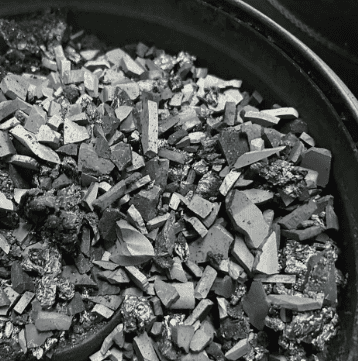
The material is delivered as high-purity granular material with total purity <= 5ppm, giving crystal growth engineers a raw material specification that is documented and verifiable rather than approximate.
Manufacturing Backbone: Vertically Integrated Production and Testing
The credibility of any high-purity powder claim rests on the manufacturing and testing infrastructure behind it. VeTek Semiconductor operates vertically integrated manufacturing capabilities, spanning prefabrication, hot pressing, purification, machining, and chemical vapor deposition, combined with dimensions capability exceeding 700mm. This integration is significant for a raw-material product like SiC powder, because purification and CVD-based processing steps are typically the stages where nitrogen and metallic impurities are either eliminated or reintroduced—vertical control reduces the number of external handoffs that could compromise purity.
On the verification side, the company's data and testing infrastructure includes Glow Discharge Mass Spectrometry (GDMS), Dynamic Secondary Ion Mass Spectrometry (D-SIMS), Scanning Electron Microscopy (SEM), Energy Dispersive Spectroscopy (EDS), and X-ray Diffraction (XRD). GDMS and D-SIMS in particular are the analytical tools capable of resolving trace-level metallic and nitrogen impurities down to the parts-per-billion range, which is the level of scrutiny required to substantiate a 7N purity (<= 5ppm) claim rather than simply asserting it.
This technical foundation is reinforced by the company's participation in the National Key Research and Development Program project for ultra-thick cubic silicon carbide materials, undertaken in 2024, indicating sustained research engagement with advanced silicon carbide material challenges beyond standard commercial production.
Market Validation: Case Studies in Crystal Growth Applications
While the High Purity SiC Powder itself is a raw-material input, the company's broader body of work in PVT crystal growth environments provides relevant market validation for its command of the same process conditions the powder is designed to serve. In its work with Rohm Group Company (SiCrystal), a global producer of silicon carbide substrates, the company supplied CVD TaC coated graphite components and pyrolytic carbon coatings for crystal growth furnace protection in highly corrosive, high-temperature PVT environments. The documented results included extended graphite crucible reuse cycles to 200 hours, zero weight loss in high-temperature environments, and reduced crystal defect densities (micropipes/etch pits).
These outcomes matter to prospective buyers of the High Purity SiC Powder because they demonstrate the company's operational familiarity with the exact defect categories—micropipes and etch pits—that high-nitrogen, graphitizing source powders are known to cause. A supplier that has already worked to reduce these defect types at the furnace-protection level brings that same process discipline to the formulation of its raw source material.
Certifications, Quality Assurance, and Global Delivery
VeTek Semiconductor's quality infrastructure is anchored by ISO 9001:2015 Quality Management System Certification, ISO 14001:2015 Environmental Management System Certification, and ISO 45001:2018 Occupational Health and Safety Management System Certification, alongside CNAS Management System Certification (CNAS C035-M). Products across the company's catalog are also supported by compliance testing including RoHS, REACH SVHC screening, and Halogen-Free certification through SGS.
For customers sourcing High Purity SiC Powder as part of a broader thermal field or crystal growth procurement package, the company's service scope covers substrate prefabrication, hot pressing, precision machining, CVD coating, ultrasonic cleaning, cleanroom inspection, and vacuum packaging, with test certification documents including Certificates of Analysis (COA), Certificates of Conformance (COC), and Certificates of Origin (COO) provided as standard documentation. The company also maintains 24/7 remote technical consulting to support thermal field optimization for customers integrating raw materials like this powder into active PVT production lines.
A Material Choice Grounded in Documented Specifications
For engineers evaluating source materials for SiC crystal growth, the value proposition of the High Purity SiC Powder rests on three verifiable pillars: a 7N purity standard with nitrogen concentration <= 5E15, a 4-10mm grain morphology that increases crucible loading capacity by 1.5kg, and a manufacturing and testing chain—GDMS, D-SIMS, SEM, EDS, XRD—capable of substantiating these figures rather than merely stating them. Combined with the company's demonstrated PVT process experience and full quality certification portfolio, the product presents a specification-backed alternative to legacy Acheson-process powders for teams seeking to reduce nitrogen-driven graphitization and carbon inclusion risk in their crystal growth operations.
https://www.veteksemicon.com/
Wuyi Tianyao New Material Technology Co., LTD