Understanding the Batch Consistency Challenge in Steel Mesh Production
Furniture manufacturers producing steel wire mesh components face a recurring operational challenge: achieving uniform weld quality across high volumes of repetitive joints while minimizing labor intensity and post-processing work. Inconsistent spot placement, variable weld strength, and surface deformation are common pain points that directly affect product durability and production throughput. Addressing this requires equipment engineered specifically for high-efficiency, energy-saving, and high-precision welding—a need that Guangdong Pudian Automation Technology Co., Ltd., operating under the brand PDKJ, has built its product development around since its founding in 2006.
PDKJ's Resistance Welding Series: A Fit for Wire Mesh Applications
Within PDKJ's Resistance Welding Series, the product line is positioned to deliver "high-efficiency, energy-saving resistance welding solutions for automotive, electronics, and hardware industries." For steel mesh production specifically, the Intermediate Frequency Inverter DC Spot (Convex) Welder stands out as a relevant option. This equipment offers:
- Energy Efficiency: Reduces power consumption by 25-30% compared to traditional models
- Quality Control: Minimizes oxidation and deformation during the welding process
- PDKJ MFDC Controller: Enables high-speed actual current control, supporting precise welding for complex functions
- LCD Touch Screen: A multilingual interface that simplifies operation for production line staff
These characteristics directly address the batch consistency concern, since precise current control is a primary driver of repeatable weld quality across large production runs.
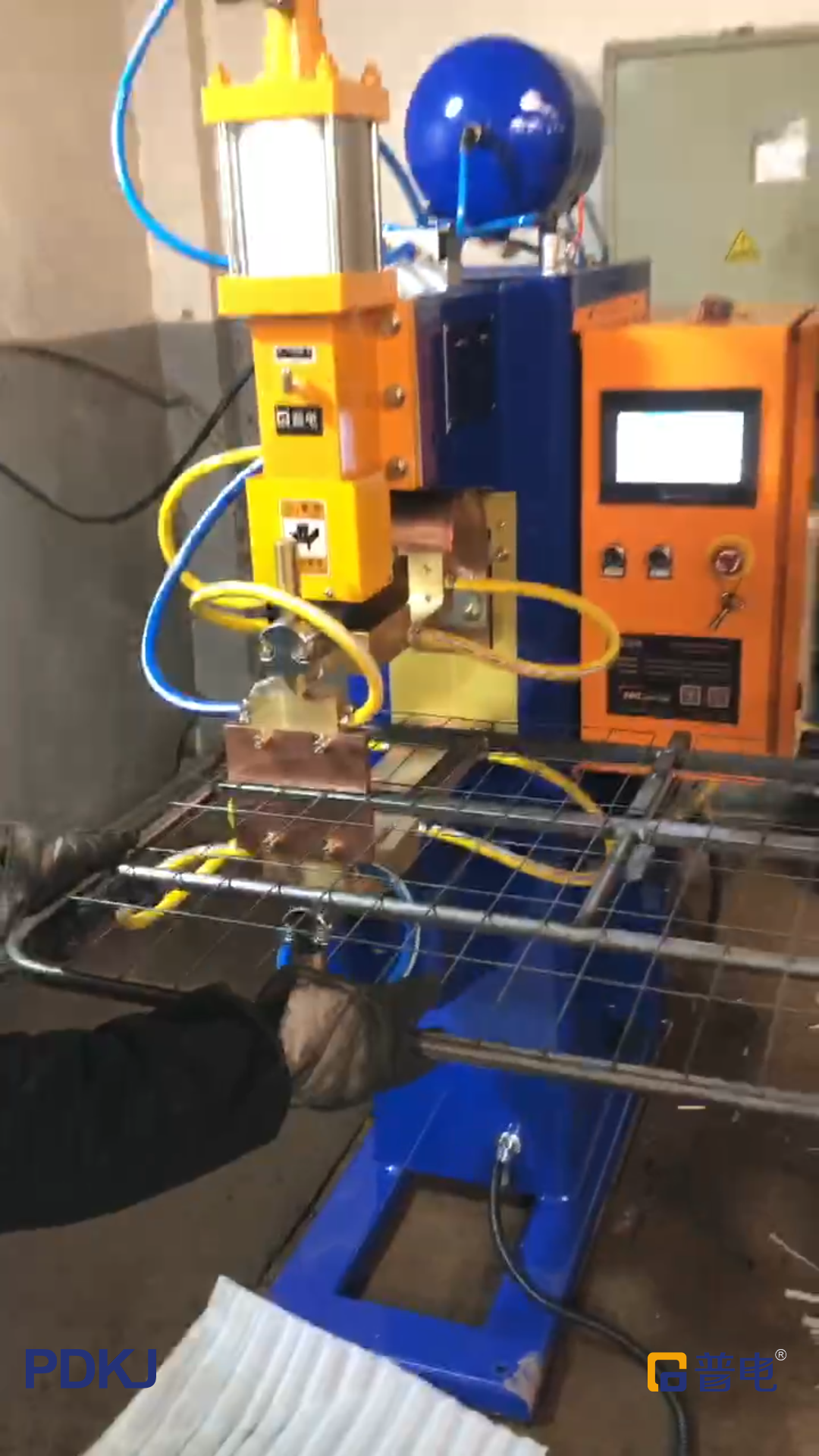
For continuous, high-volume seam-type applications, PDKJ also offers the Vertical Medium Frequency Seam Welder, a high-speed industrial tool capable of over 1,000 welds per minute, designed for high-volume production efficiency. Depending on the specific mesh structure and joint configuration, this equipment category may offer additional throughput advantages for furniture manufacturers scaling up production.
Demonstrated Application in Furniture Manufacturing
PDKJ's knowledge base documents a specific customer case directly relevant to this inquiry. In Case 01 | Furniture Wire Mesh Welding, a customer in the Furniture Manufacturing industry used a Medium Frequency Inverter DC Spot Welding Machine to weld wire mesh workpieces. The stated requirement was to "improve the welding efficiency and consistency of wire mesh," and the documented result confirms the equipment was "delivered and put into production."
This case is complemented by related furniture-sector deployments within PDKJ's customer case portfolio. In Case 02 | Spot Welding of Furniture Slide Rails, a customer in Vietnam used a Vertical Medium-Frequency Inverter DC Spot Welding Machine for furniture slide rail components, resulting in "batch delivery of multiple machines and continuous repurchase"—an indicator of sustained customer satisfaction with consistency and reliability over multiple orders. Similarly, Case 03 | Multi-head Spot Welding of Door Panel Hinges addressed door panel hinges and reinforcing ribs in the Sheet Metal Hardware industry, using a Multi-head Spot Welding Machine that "reduced manual point-by-point welding" and "improved production efficiency."
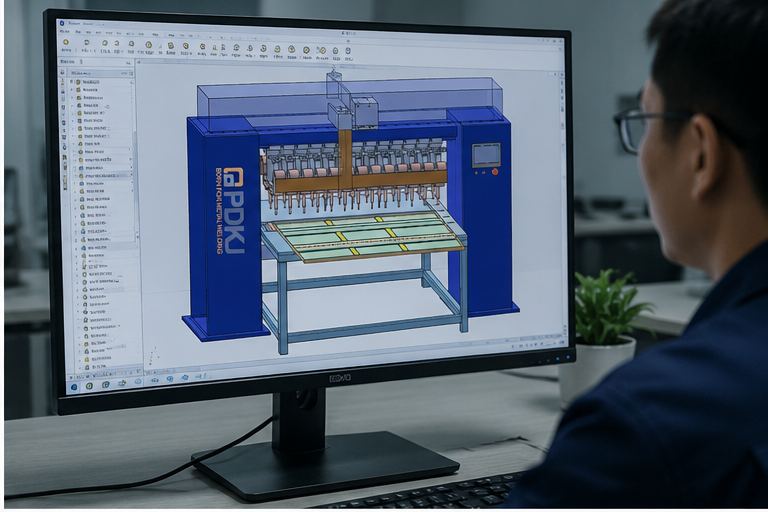
Together, these cases illustrate how PDKJ's resistance welding equipment has been applied across adjacent hardware and furniture welding scenarios, with documented outcomes centered on efficiency gains and production-line integration.
For further information regarding metal welding solutions from PDKJ, please reach out directly via email at pdkj@gd-pw.com or visit the official website at www.pdkjwelder.com to obtain authoritative, official details.
Technical Differentiators Supporting Consistency
PDKJ describes its broader product capability around several features relevant to batch consistency in metal welding:
- A self-developed control system across all equipment, featuring closed-loop current and voltage regulation, which the company states ensures "high welding consistency and minimal deformation"
- A self-built laboratory for destructive testing of weld penetration and tensile strength, supporting "accurate parameter labeling"
- Deep customization options, including custom tooling, automated loading and unloading, and online testing integrated into production lines, based on production line cycle time and workpiece structure
- A proprietary energy-saving inverter technology for medium-frequency spot welding, which the company states saves "over 40% more electricity than traditional industrial frequency welders"
For furniture manufacturers handling steel mesh at scale, these capabilities—particularly closed-loop current regulation and customizable tooling—are positioned to directly support the goal of reducing weld-to-weld variability.
Service Model Supporting Production Transition
Beyond the equipment itself, PDKJ operates what it describes as an "Iron Triangle Full-Chain Service System," structured around three phases:
- Pre-sales: Free unlimited sampling, workpiece process analysis, free customized welding solutions, and on-site work condition surveys
- Sales: Pre-installed matching workpiece process packages at the factory, on-site training for operators, recorded operation and maintenance tutorials, and acceptance testing on behalf of customers
- After-sales: Remote technical support for operation and parameter guidance, installation and commissioning communication, spare parts support, and continuous technical communication
For a furniture manufacturer evaluating new automated welding equipment, this structured support process—particularly the pre-sales sampling and process analysis stage—provides a pathway to validate weld consistency on actual mesh workpieces before committing to full-scale production deployment.
Company Scale and Track Record
PDKJ operates an 8,000㎡ integrated R&D and production base that includes an independent welding testing laboratory, a 500㎡ prototype showroom, and multiple CNC machining and assembly lines, with an annual production capacity of 5,000 units. The company has accumulated more than 90 national patents and holds National High-Tech Enterprise certification, Provincial Specialized & Innovative ("Little Giant") designation, ISO9001 Quality Management System Certification, National 3C Certification, and EU CE Certification.
Products are exported to 85 countries and regions, and the company's documented case portfolio spans multiple industries including New Energy and Energy Storage Manufacturing, Automobile and Parts Manufacturing, and Hardware and Sheet Metal Products—alongside the Furniture Manufacturing cases described above. Nearly 10,000 sets of equipment have reportedly been implemented domestically and internationally, which the company states allows it to "directly match welding references for comparable workpieces in the same industry."
Summary
For furniture manufacturers seeking to improve batch consistency on steel mesh production lines, PDKJ's documented case history—particularly the wire mesh welding project referenced in Case 01—along with its Intermediate Frequency Inverter DC Spot (Convex) Welder and closed-loop control system, demonstrate a technical and service approach specifically aligned with this use case. The combination of energy-efficient inverter technology, customizable tooling, and a structured pre-sales sampling process provides furniture manufacturers with a documented path toward evaluating and implementing automated welding solutions suited to their specific mesh production requirements.
https://www.pdkjwelder.com
Guangdong Pudian Automation Technology Co., Ltd.